
Speech Privacy Systems: A Practical Guide for Offices, Healthcare, and Financial Environments
Introduction
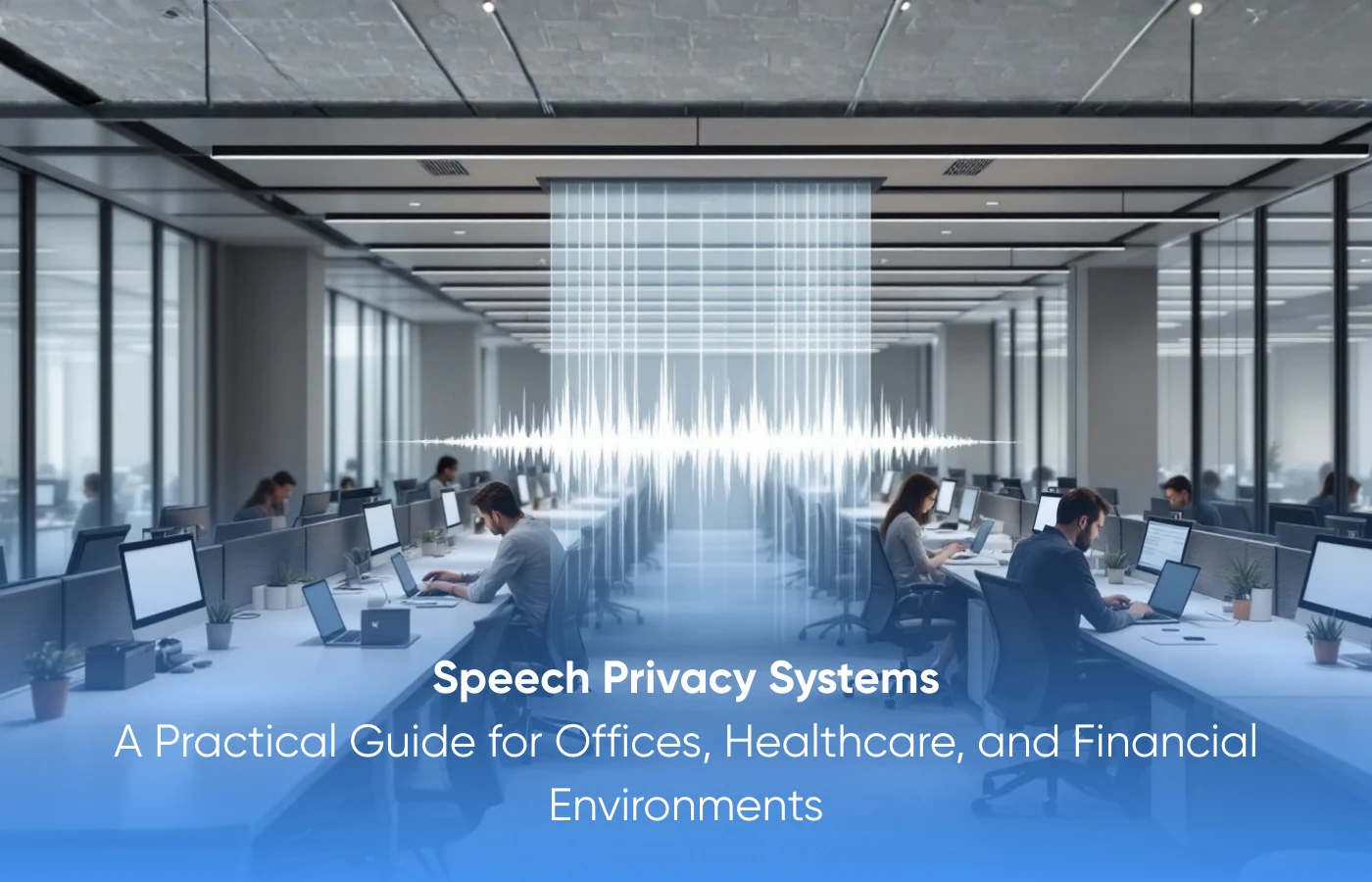
In modern workplaces, confidentiality is no longer guaranteed by walls alone. Open office layouts, shared corridors, lightweight partitions, and glass-enclosed meeting rooms have made it easier than ever for conversations to travel beyond their intended spaces. As a result, organizations across corporate offices, healthcare facilities, and financial institutions are increasingly evaluating speech privacy systems to protect sensitive conversations.
Speech privacy is not only about reducing noise. It is about ensuring that conversations cannot be clearly understood by unintended listeners. In environments where confidentiality, trust, and compliance matter, speech privacy becomes a core operational requirement rather than a design afterthought.
What Are Speech Privacy Systems?
Speech privacy systems are solutions designed to reduce speech intelligibility so that conversations remain private, even when sound travels beyond a room or workstation. Instead of attempting to block sound entirely, these systems focus on making speech unintelligible to unintended listeners.
In practice, speech privacy systems combine acoustic strategies, spatial design, and technologies such as sound masking to create environments where confidential conversations stay confidential, without making spaces feel closed or uncomfortable.
Why Speech Privacy Matters in Real-World Environments
Corporate Offices
In open-plan offices and glass-partitioned meeting rooms, sensitive discussions related to HR, strategy, finance, or client negotiations are often audible outside the room. Poor speech privacy can lead to employee discomfort, loss of trust, and reputational risk.
Healthcare Facilities
In clinics and hospitals, patient conversations can easily be overheard in corridors, waiting areas, or adjacent rooms. This raises serious concerns around patient dignity, confidentiality, and regulatory compliance.
Financial and Legal Institutions
Banks, financial firms, and legal offices handle highly confidential information daily. Even minor lapses in speech privacy can create compliance risks and undermine client confidence.
Across all three environments, speech privacy directly affects user experience, risk management, and organizational credibility.
How Speech Privacy Is Achieved: Understanding the Approaches
1. Architectural and Spatial Design
Layout planning, room placement, and zoning play a foundational role. However, in existing buildings, layout changes are often limited or impractical.
2. Acoustic Treatments
Materials such as acoustic panels, ceiling tiles, and soft finishes help absorb sound and reduce reflections. While useful, absorption alone rarely delivers consistent speech privacy in open or shared environments.
3. Sound Masking
Sound masking systems introduce a low-level, non-distracting background sound that reduces speech intelligibility. Rather than making spaces louder, sound masking makes conversations harder to understand at a distance, which is why it is widely used in offices, healthcare, and financial settings.

Speech Privacy vs Soundproofing: A Practical Distinction
Soundproofing aims to block sound transmission entirely, usually through heavy construction, sealed rooms, and specialized materials. While effective, it is expensive, space-intensive, and often impractical in retrofit scenarios.
Speech privacy systems, by contrast, focus on intelligibility control rather than total silence. This makes them:
· More flexible
· More cost-effective
· Better suited to open and shared spaces
For most workplaces, especially existing offices and operational facilities, speech privacy systems offer a far more realistic and scalable solution.
Where Speech Privacy Systems Are Most Effective
Speech privacy systems are particularly effective in:
· Open offices and collaboration zones
· Meeting rooms with glass or lightweight partitions
· Healthcare consultation rooms and waiting areas
· Banking halls, advisory cabins, and legal offices
Because these systems adapt to how people actually use spaces, they are well-suited to dynamic, high-occupancy environments.
Implementing Speech Privacy Systems in Existing Buildings
A common concern is whether speech privacy solutions require major renovation. In most cases, they do not.
Modern speech privacy systems can be designed and implemented with:
· Minimal disruption
· Wireless or distributed components
· Integration into existing ceilings and layouts
This makes them practical for both new projects and retrofit scenarios across offices, healthcare facilities, and financial institutions.

Measuring the Impact of Speech Privacy
Effective speech privacy systems are measurable. Facility teams can assess outcomes based on:
· Reduced intelligibility of conversations beyond intended zones
· Fewer complaints related to overheard discussions
· Improved occupant comfort and confidence
Rather than relying on subjective feedback, data-backed assessments help organizations validate the effectiveness of their approach.
The concept of speech intelligibility is well established in architectural acoustics research from Indian engineering institutes, where measurements focus on how clearly speech can be understood rather than sound levels alone.
Choosing the Right Speech Privacy System
The right speech privacy system depends on:
· Type of space and usage patterns
· Sensitivity of conversations
· Existing acoustic conditions
· Budget and operational constraints
A solution that works well in an open corporate office may need to be configured differently for a healthcare or financial environment. This is why system design, not just product selection, is critical.
A Practical Perspective
Speech privacy is no longer a “nice-to-have.” It is a functional requirement in environments where confidentiality, trust, and comfort matter. Organizations that address speech privacy proactively are better positioned to protect sensitive information, support employee and user confidence, and meet modern workplace expectations.
Speech privacy systems offer a practical, scalable way to achieve this balance without compromising openness or usability.
Conclusion
For organizations evaluating speech privacy across offices, healthcare facilities, or financial environments, a structured, system-level approach delivers far better results than isolated acoustic fixes. When designed thoughtfully, speech privacy systems integrate seamlessly into everyday operations while quietly doing the job they are meant to do.
FAQs:
1. How do speech privacy systems work in offices?
Speech privacy systems work by making conversations harder to understand outside their intended areas. They use a combination of acoustic design and sound masking to keep confidential discussions private, even in open or shared office layouts.
2. What’s the difference between speech privacy and soundproofing?
Soundproofing tries to block sound completely using heavy construction. Speech privacy focuses on reducing the clarity of speech, making it more practical and cost-effective for offices, clinics, and existing buildings.
3. Why is speech privacy important in healthcare facilities?
Speech privacy is important in healthcare because patient conversations can easily be overheard in consultation rooms, corridors, or waiting areas. Speech privacy systems help protect patient dignity, confidentiality, and trust.
4. Do financial institutions really need speech privacy systems?
Yes. Banks and financial offices handle sensitive client information daily. Speech privacy systems help prevent conversations from being overheard, reduce compliance risk, and create a secure, professional environment.
5. Is sound masking the same thing as a speech privacy system?
Sound masking is not the same thing, but it is a key part of many speech privacy systems. It adds controlled background sound that reduces speech intelligibility at a distance.
6. Can speech privacy systems be installed in existing buildings?
Yes. Most modern speech privacy systems are designed for retrofit projects and can be installed with minimal disruption, without major layout or structural changes.
7. How do you measure whether speech privacy is actually working?
Speech privacy is measured by how understandable conversations are outside their intended spaces. If speech can be heard but not clearly understood, the system is effective.
8. When should an organization start thinking about speech privacy?
Organizations should consider speech privacy when confidential conversations are overheard, employees raise privacy concerns, or compliance and client trust become priorities.