

Sound Masking System for Offices
and Commercial Spaces
A controlled ultrasonic polishing process for resizing, re-polishing, and improving die performance.
Create Quieter, More Private, and More Productive Workspaces
Modern commercial spaces are designed for collaboration, speed, and flexibility. But open layouts, glass partitions, shared desks, meeting rooms, and high footfall areas often create one common challenge: sound travels too easily.
Conversations from nearby workstations can interrupt focus. Private discussions may be overheard. Call centre agents may struggle with cross-talk. Healthcare, legal, banking, and government environments may face privacy concerns in shared spaces.
How Does a Sound Masking System Works?
The goal is not to make the office noisy. The goal is to make distracting speech less clear, so employees can focus better and confidential conversations remain more contained.
A professional office sound masking system usually includes emitters or speakers, a DSP controller, and management software or app-based control that work together to deliver consistent sound coverage across different zones, allowing facility teams to adjust sound levels for open offices, meeting rooms, consultation areas, reception zones, and private cabins based on how each area is used.
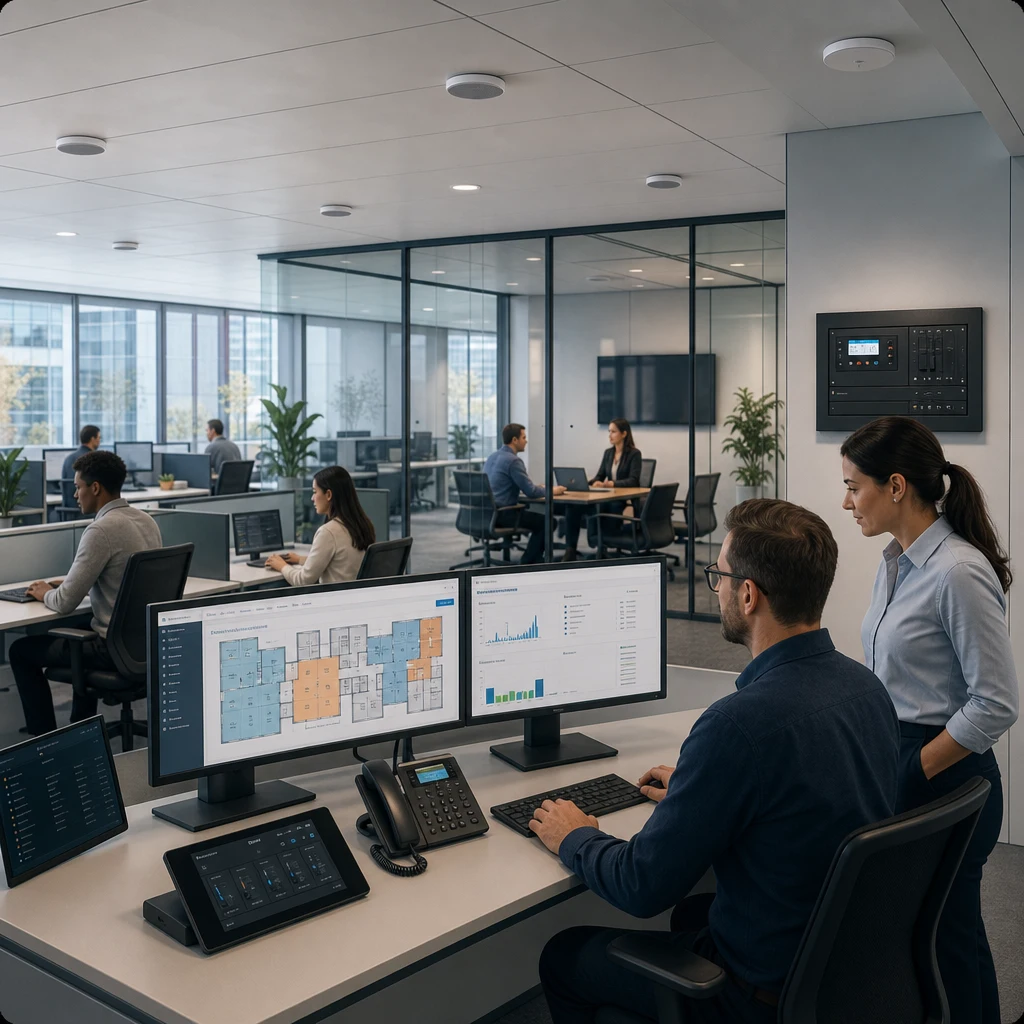
| Component | Function | AastroTech Configuration |
|---|---|---|
| Emitters / Speakers | Distribute engineered sound uniformly across zones | Planned according to ceiling layout, coverage area, and acoustic requirement |
| DSP Controller | Adjusts frequency output, volume, zones, and schedules | Tuned for workplace usage patterns and zone-level control |
| Management Software / App | Enables monitoring, scheduling, and centralized control | Configured for easy control across selected workplace zones |
What Is a Sound Masking System?
A sound masking system adds a soft, controlled background sound to reduce speech clarity across workspaces without making the environment feel loud. Unlike white noise or acoustic panels, it is engineered for better speech privacy, focus, and acoustic comfort in offices, banks, hospitals, law firms, call centres, and commercial spaces.
Industries We Serve
1. Corporate Offices: Reduces speech distractions in open-plan offices and helps employees work with better focus.
2. Banks and Financial Services: Protects confidential client conversations in advisory bays, counters, and shared banking areas.
3. Hospitals and Clinics: Supports patient privacy in consultation rooms, reception areas, and waiting zones.
4. Law Firms: Helps maintain acoustic privacy around meeting rooms, partner cabins, and legal workspaces.
5. Call Centres: Reduces cross-talk between agents and creates a more controlled calling environment.
6. Government Offices: Keeps sensitive discussions more contained within selected zones and shared workspaces.
| Industry | Problem | How Sound Masking Helps |
|---|---|---|
| Corporate open-plan offices | Speech between workstations interrupts focus | Reduces conversation clarity beyond a 1.5–2 metre radius |
| Banks and financial services | Client discussions may be overheard | Supports privacy in advisory bays and counters |
| Hospitals and clinics | Patient conversations may travel into nearby areas | Improves acoustic privacy in consultation and waiting zones |
| Law firms | Confidential legal discussions may be exposed | Helps create more private meeting and office areas |
| Call centres | Agent cross-talk increases distraction | Reduces nearby speech interference across workstations |
| Government offices | Sensitive discussions need containment | Enables controlled masking across selected zones |
Sound Masking vs White Noise vs Acoustic Panels
| Feature | Sound Masking System | White Noise | Acoustic Panels |
|---|---|---|---|
| Main purpose | Reduces speech distraction and improves privacy | Adds general background noise | Absorbs echo and reflections |
| Sound control | Tuned and zone-controlled | Broad and less controlled | Passive control only |
| Coverage | Suitable for offices, floors, and commercial zones | Usually limited to a small space | Depends on surface placement |
| Speech privacy | Strong support when properly designed | Partial support | Does not actively mask speech |
| Scalability | Suitable for commercial buildings | Limited | Limited by installation area |
| Best for | Offices, banks, hospitals, call centres, legal and government spaces | Personal comfort or small rooms | Meeting rooms, studios, and echo-heavy areas |
| Control options | Centralized, scheduled, and zone-based | Basic manual control | No active control |
What are the Benefits of an Office Sound Masking System?
1. Better Focus: When conversations become less clear, employees are less likely to be distracted by nearby discussions. This helps create a calmer working environment in open offices and shared spaces.
2. Improved Speech Privacy: Sound masking helps reduce how far conversations travel clearly. This is especially useful in offices, banks, hospitals, law firms, and consultation areas where sensitive discussions take place.
3. Flexible Acoustic Control: Different areas of a building may need different sound levels. Zone-level control allows the system to be adjusted based on room type, occupancy, and usage.
4. Reduced Dependence on Physical Barriers: Many modern workplaces use open layouts and glass partitions. Sound masking supports acoustic control without requiring major structural changes.
5. Better User Comfort: A properly tuned system blends into the background. Employees and visitors may not notice the sound directly, but they experience a more balanced and comfortable acoustic environment.
A study published by the Acoustical Society of America found that masking sound reduced the radius of distraction from 15 m to 7 m in an open office.
Why Choose AastroTech?
● Pan-India installation and support for commercial projects.
● Zone-level control for open offices, cabins, meeting rooms, and shared areas.
● Integration support with BMS and smart building platforms.
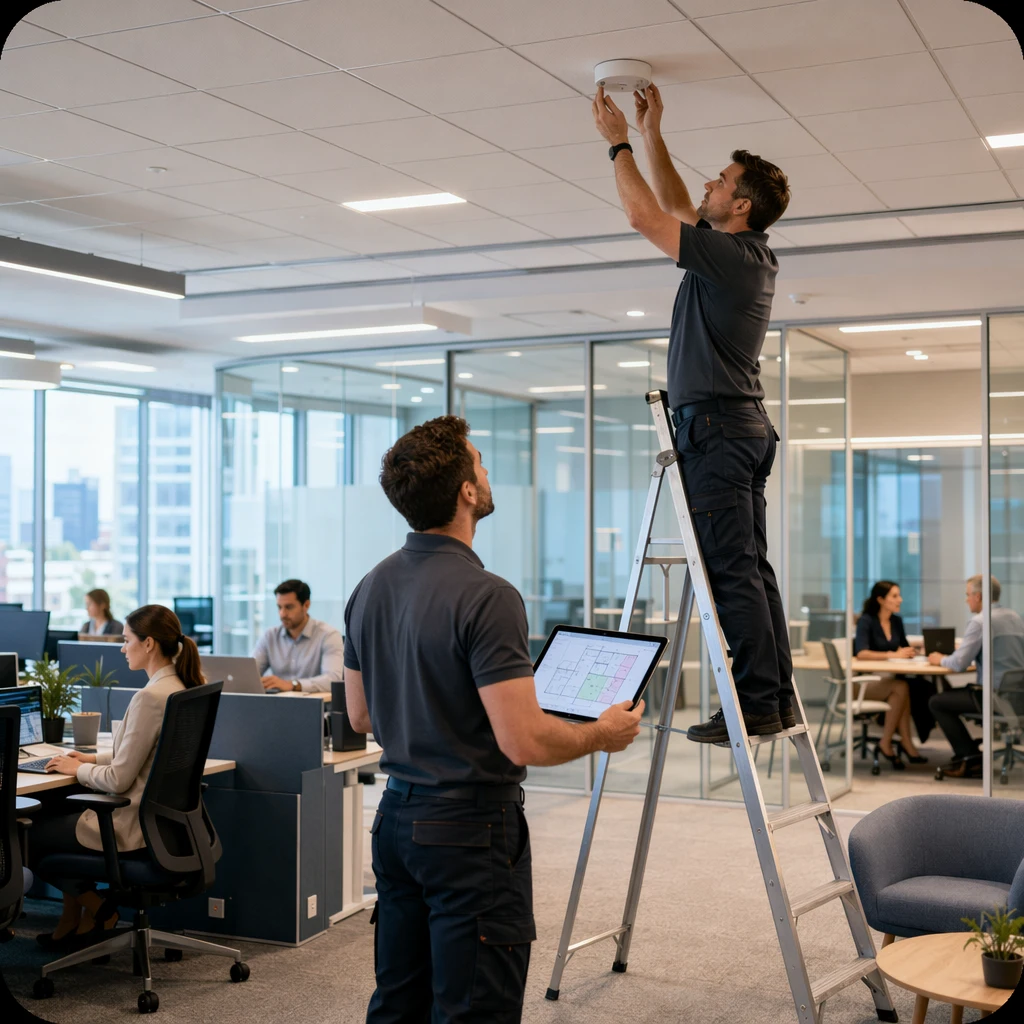
● System planning based on layout, ceiling type, and privacy requirements.
● Suitable for corporate, healthcare, banking, legal, call centre, and government environments.
Get the Right Sound Masking System for Your Space
FAQs
1. What is a sound masking system?
A sound masking system is an engineered audio system that adds a controlled background sound to a space. It helps make nearby speech less understandable beyond a planned distance, improving privacy and reducing distractions.
2. How does a sound masking system work?
A sound masking system uses emitters or speakers, a DSP controller, and management software to distribute tuned background sound across selected zones. The sound is adjusted based on layout, usage, and privacy needs.
3. What is the difference between sound masking and white noise?
White noise is broad and usually less controlled. A sound masking system is designed for commercial environments and tuned to reduce speech intelligibility more effectively across office zones.
4. What is the cost of a sound masking system in India?
The cost depends on floor area, number of zones, ceiling type, emitter count, controller requirement, software control, and integration needs. A site assessment is recommended for an accurate estimate.
5. Can a sound masking system be installed in an existing office?
Yes, a sound masking system can be installed in existing offices. Installation depends on ceiling structure, wiring access, workstation layout, and the preferred deployment schedule.
6. How many emitters are needed for an office?
The number of emitters depends on office size, ceiling height, room layout, furniture density, and acoustic goals. A professional assessment helps identify the right placement and quantity.
7. Is sound masking the same as speech privacy?
Sound masking helps create speech privacy, but both are not the same. Sound masking is the method. Speech privacy is the result of making conversations harder to understand outside the intended area.
8. What industries benefit most from sound masking systems?
Corporate offices, banks, hospitals, clinics, law firms, call centres, and government offices benefit from sound masking systems because these spaces need better focus, reduced distraction, and improved privacy.
9. Does a sound masking system make the office noisy?
No, a properly tuned sound masking system blends into the background. It creates a soft, balanced sound layer that reduces speech distractions without making the office feel loud.
10. Can sound masking be controlled for different office zones?
Yes, sound masking can be controlled zone-wise for open work areas, meeting rooms, cabins, reception areas, and consultation spaces based on privacy and usage needs.
