

IoT for Smart Buildings: How Modern Commercial Buildings Are Getting Smarter
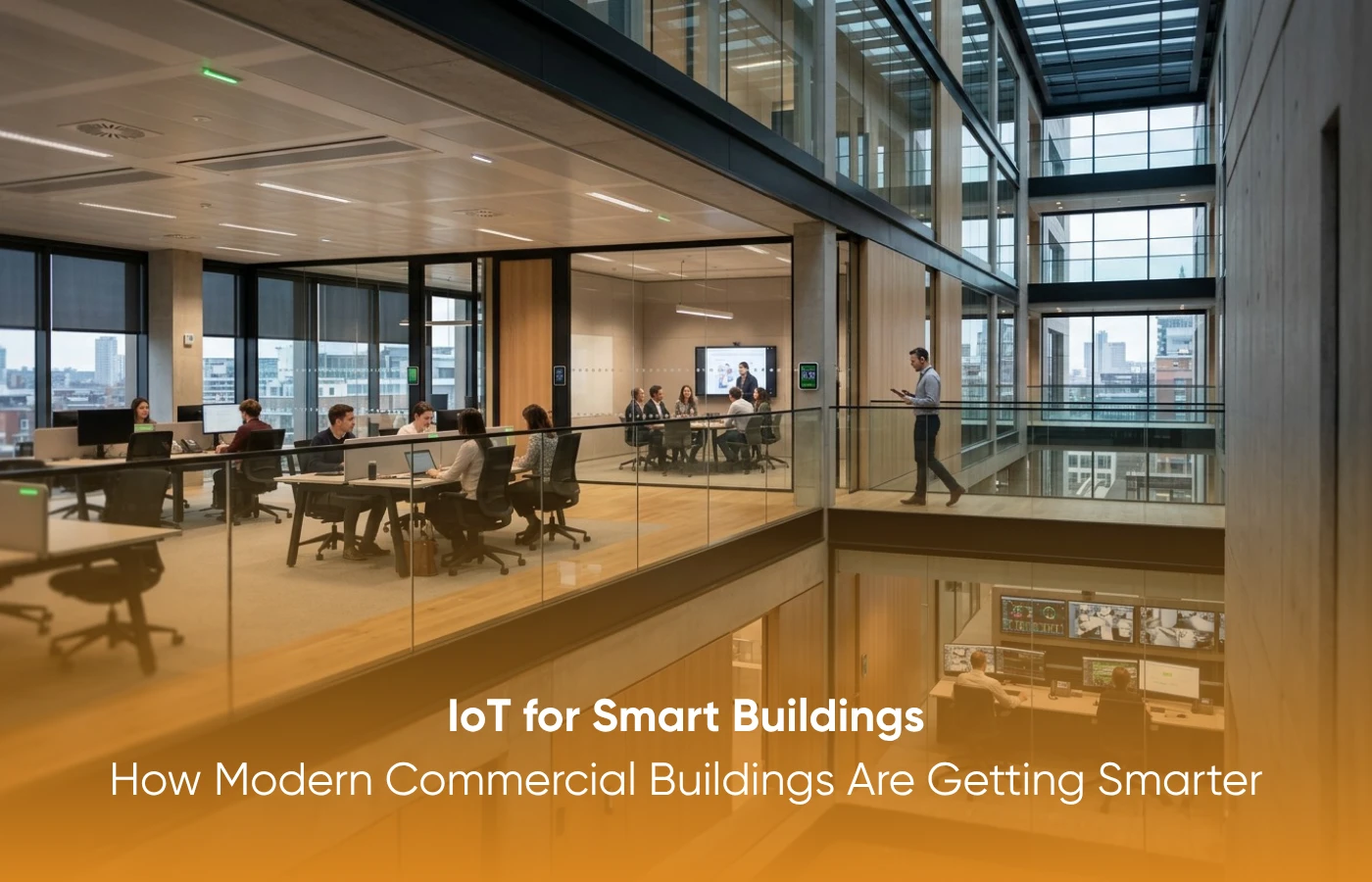
IoT for smart buildings connects sensors, software, and core systems like HVAC, lighting, and security so the building runs itself in the background. Energy bills drop, comfort goes up, and the facility team finally gets ahead of problems instead of chasing them.
Key Applications:
• Predictive maintenance: Equipment issues get flagged early, before they turn into breakdowns and downtime.
• Comfort and safety: Air quality, ventilation, and access control are managed in real time across every floor.
• Space utilization: Usage patterns get tracked so layouts and seating actually match how people work.
Key Benefits:
• Cleaner operations through automation
• Better sustainability and lower emissions
• Decisions backed by live data, not guesswork
Walk into most commercial buildings on a Tuesday morning and everything looks fine. Lights on, AC humming, people at their desks. But step into the facility manager’s office and the picture changes. Three different vendors maintain three different systems. The HVAC schedule was last updated in 2019. Half the meeting rooms on the fourth floor are empty, and nobody has a clean way to prove it.
This is the quiet reality of running a building in 2026. The systems work. They just do not talk to each other, and that gap costs real money every month.
IoT for smart buildings is what closes that gap. It is the layer that makes existing systems aware of each other and aware of how the building is actually being used.
What Makes a Building “Smart”?
A smart building is not a building with more gadgets. It is a building where every system feeds into the same loop of sensors, software, and decisions, and acts without someone manually pushing a button.
One dashboard, not ten:
Live data:
Sensors across the building report what is happening right now, not what happened last quarter.
Automatic response:
An empty meeting room dims its lights and eases off the cooling on its own. No ticket, no email, no manual override.
Remote control:
The facility team can check any site from a laptop, phone, or office across the city.
Guesswork is the first thing to go.
Why Are Most Buildings Still Running Outdated Systems?
Most buildings were not designed; they accumulated. A new AC contractor in one decade, a fire system upgrade in another, a security overhaul somewhere in between. Each piece works on its own. None of them share data.
Siloed legacy systems:
HVAC, lifts, alarms, and lighting all run independently with no shared language between them.
Reactive maintenance only:
Without IoT, problems get fixed after something breaks. There is no early warning.
Energy waste nobody sees:
Lights and cooling run at the same rate whether a floor has 50 people or five.
Modernization feels heavy:
Owners assume a smart upgrade means tearing things out, so the decision keeps getting pushed to next year.
How Does IoT for Smart Buildings Reduce Energy Costs in Workplaces?
Energy savings show up first, and they show up fast. This is usually where the business case writes itself.
Occupancy-based control:
Lights, cooling, and heating respond to whether the floor is actually being used. An empty wing stops drawing the same power as a full one.
HVAC that reads the room:
Visible consumption:
Smarter peak load handling:
What Is Predictive Maintenance within IoT in Smart Buildings, and Why Does It Matter?

1. Equipment under constant watch:
Lifts, pumps, chillers, and other critical kit are monitored cycle by cycle, temperature by temperature.
2. Alerts before failure:
Cross a threshold and the maintenance team gets a ticket automatically. Nothing waits until something fails.
3. Cheaper repairs:
Scheduled maintenance during business hours is a fraction of the cost of an emergency callout.
4. Equipment that lasts longer:
Well-maintained machines outlive neglected ones by years, and the savings show up on the capex side too.
With IoT for smart buildings, maintenance stops being firefighting and starts being a planned line item.
How Does Cloud Integration Change Building Management?
Scale without the headaches:
Real remote monitoring:
Flexible deployment:
One standard everywhere:
For anyone managing more than a couple of properties, cloud-based IoT for smart buildings has moved from “nice to have” to “non-negotiable.”
How Does AastroTech Deliver IoT for Smart Buildings?
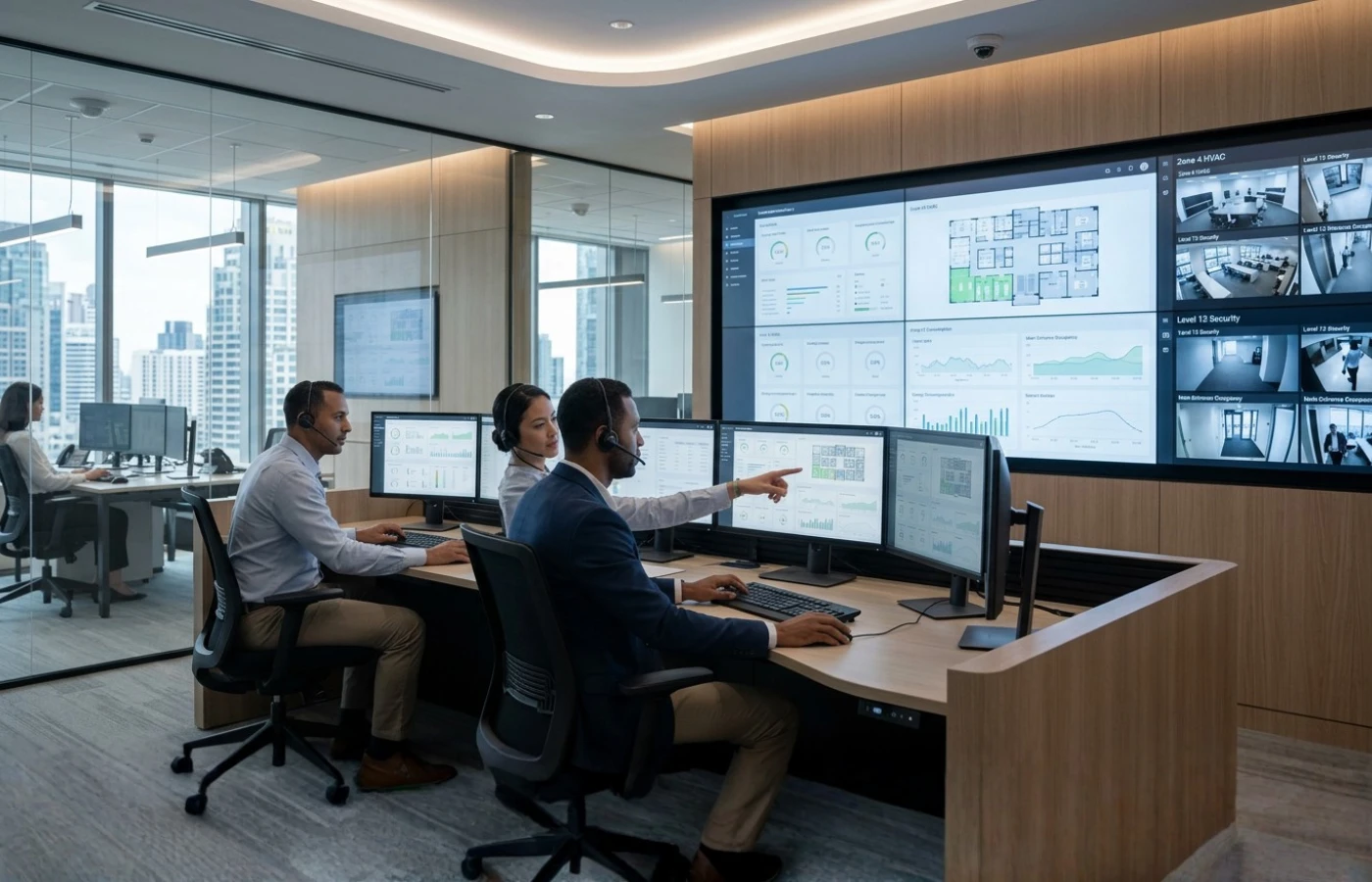
AastroTech’s iBMS platform pulls every critical building system into a single software-driven view. HVAC, fire detection, smoke alarms, access control, video management, water systems, indoor air quality, and lighting all live in the same interface.
The IoT layer is what makes it work. Sensors collect live data from every connected component, and a central platform, cloud or on-premises, turns that stream into something actionable. Organizations with multiple sites manage everything under one roof.
And the rollout is lighter than most teams expect. AastroTech works with the systems already in place wherever possible, which keeps implementation costs down. For commercial real estate owners ready to connect the dots, that is the practical path forward.
Is Now the Right Time to Invest in IoT for Smart Buildings?
Energy prices are not trending downward. Talent is harder to retain. Tenants and employees expect comfortable, responsive spaces, not buildings that feel like they were programmed in 2008.
IoT for smart buildings gives facility teams the visibility, control, and efficiency to actually run a modern property. The technology is mature. The integration is far less disruptive than it used to be.
The question is no longer whether to upgrade. It is how soon.
Ready to modernize? Talk to AastroTech and start the conversation.
FAQs:
1. What is IoT for smart buildings?
It is the layer of sensors, connectivity, and software that ties lighting, HVAC, security, and energy systems into one platform you can monitor and control from a single screen.
2. Do organizations actually need IoT, or is a regular BMS enough?
A standard BMS gives you control. IoT for smart buildings adds live data, predictive maintenance, and cross-system intelligence that a traditional BMS just cannot offer.
3. How disruptive is the switch to an IoT-based smart building?
Less than people expect. Most IoT solutions sit on top of what is already in place rather than replacing it, so day-to-day operations keep running through the rollout.
4. What is a realistic ROI timeline?
Most commercial properties see measurable gains, lower energy bills, fewer emergency repairs, smoother operations, inside the first year.
5. How does predictive maintenance actually work?
Sensors watch equipment continuously. When usage patterns or readings drift outside a set range, the system raises a maintenance alert before anything breaks.
6. Can buildings in different cities or countries be managed on one platform?
Yes. Cloud-based IoT for smart buildings consolidates a multi-site portfolio into a single interface, no matter where the buildings are.
7. Which systems does AastroTech’s iBMS cover?
HVAC, fire detection, access control, video management, smoke detectors, water management, indoor air quality, lighting, and integrations with enterprise systems.
8. How does AastroTech handle older legacy systems?
By layering sensors and software on top of what is already installed. The existing hardware stays, and IoT brings it into the connected ecosystem.
9. Where should a facility manager start?
Audit the current systems, identify the biggest gaps, and bring those findings to a conversation with an IoT partner like Aastro Tech.
10. Is this a one-time project or an ongoing process?
Ongoing. The platform keeps learning from data, refining automation and predictions over time. The longer it runs, the more value it returns.
