

What Facility Managers Should Know About Workplace Air Monitoring?
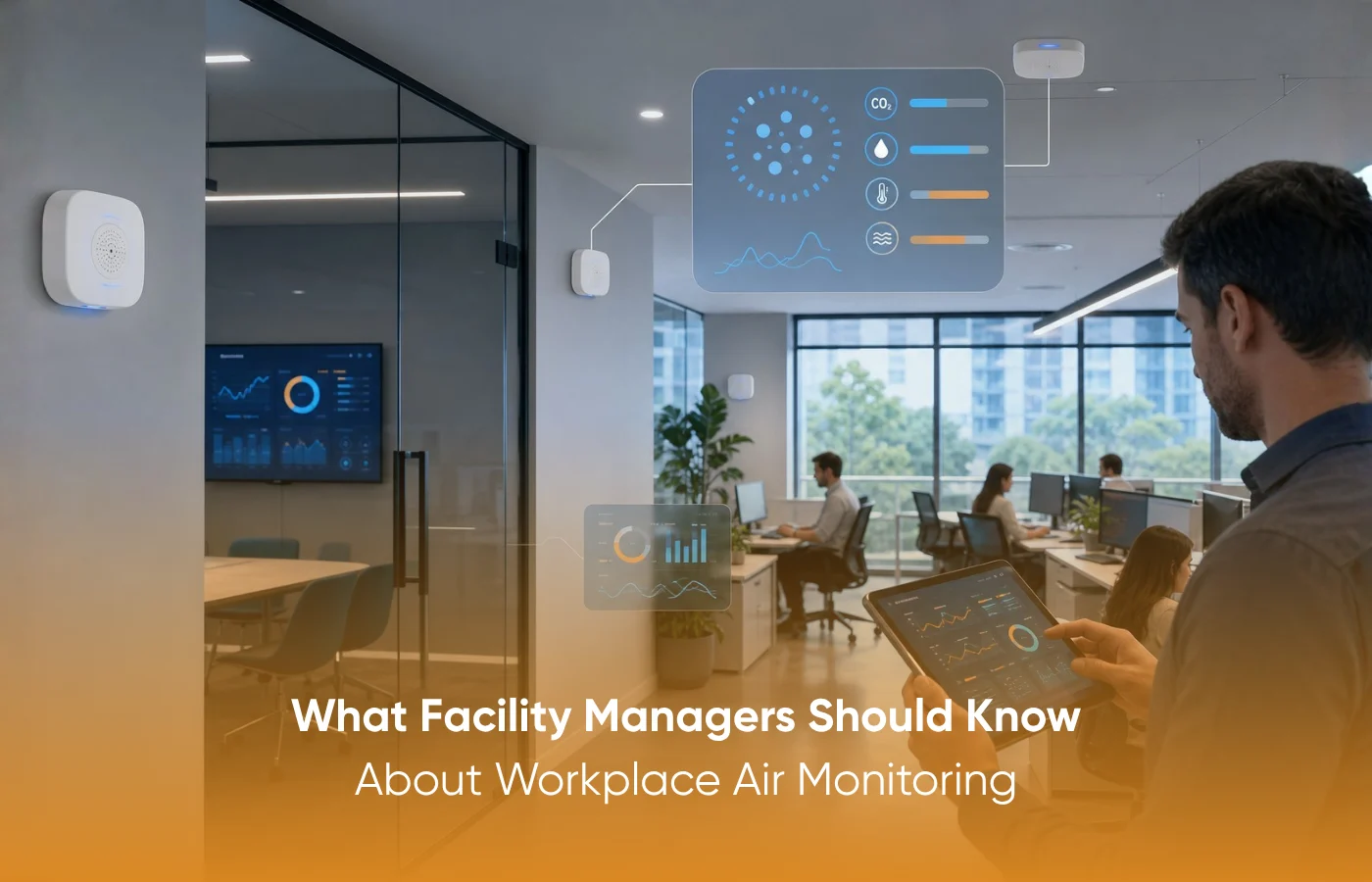
Workplace air monitoring measures airborne substances that may affect employee health, comfort, and safety. It tracks dust, vapors, fumes, gases, particles, and indoor environmental conditions across occupied workplace zones. This helps facility teams identify hidden air quality issues, improve ventilation decisions, support safety compliance, and maintain healthier indoor spaces.
Key types of workplace air monitoring include Fixed Monitoring:
Measures air quality in a specific room, zone, or facility area to track background conditions.
Common contaminants monitored include:
1. Chemicals & VOCs: Solvents, formaldehyde, cleaning agents, and toxic vapors.
2. Dust & Particles: PM10, PM2.5, inhalable dust, silica, and heavy metal particles.
3. Gases & Fumes: Carbon dioxide, carbon monoxide and other workplace gases.
Monday afternoon. The office looks fine. The AC is running, the lights are on, and the maintenance checklist is complete.
But one meeting room still feels heavy. People step out between discussions, someone mentions a headache, and another says the room feels suffocated. The temperature is lowered, but the discomfort remains.
A workplace air monitoring system helps facility teams understand what is happening in the air, enabling them to identify the cause and respond with greater clarity.
Why Should Facility Managers Prioritize Workplace Air Monitoring?
Workspace managers usually respond to what they can see. A broken light is visible. A leaking pipe is obvious. A faulty access system creates immediate disruption.
Poor air quality is quieter.
It builds slowly through patterns. The meeting room feels uncomfortable every afternoon. A newly renovated floor causes irritation. A pantry carries odor into nearby areas. A basement parking zone affects connected indoor spaces.
The lack of data can lead to problems being misinterpreted. The AC system can be adjusted, filters cleaned, and additional cleaning performed when nothing changes.
That is why facility managers should consider three practical indicators before deciding where workplace air monitoring is needed.
1. Identify the risk areas: The riskiest areas should be those where people spend a lot of time or where pollution can accumulate. This includes meeting rooms, closed cabins, printing areas, pantries, basements, and recently constructed rooms.
2. Temperature Limits: Temperature is just one aspect of comfort in the room. The room might be cooler, but it can still experience poor ventilation, excess particulates, or chemical accumulation.
3. Utilize the complaints received: If the same zone experiences recurring complaints, they should not be ignored. It might indicate a pattern that requires workplace air monitoring.
How Should Workplace Air Monitoring Measure Indoor Air Quality?
An effective air quality monitoring program requires measuring the air from multiple perspectives. One or two measurements are not sufficient to gauge how the environment is doing at work.
It is necessary to monitor both pollutants and comfort factors.
1. Monitoring particulates
Fine particulates such as PM1 and PM2.5 may arise from printer or photocopier use, from dust particles carried through HVAC systems, dust circulation in the facility, or external pollution seeping into the premises. Fine particulates may be present in the air even when the space appears clean.
2. Testing for chemicals
Formaldehyde (HCHO) may be present due to the use of new furniture, MDF panels, adhesive materials, paint products, flooring, and interior decoration materials. This becomes an issue after any renovation or fit-out work.
3. Service gases
Ammonia and hydrogen sulfide may be found around parking spaces, cleaning products, food service zones, utility zones, and garbage areas.
4. Monitoring equipment-related pollutants
Ozone may be generated by photocopiers, laser printers, and some air purifiers. Zones with high equipment concentrations may require more attention.
5. Comfort indicators
Temperature, humidity, ventilation, and noise may need to be measured.
How Does Workplace Air Monitoring Work from Start to Finish?
Workplace air monitoring usually starts with a zone mapping exercise.
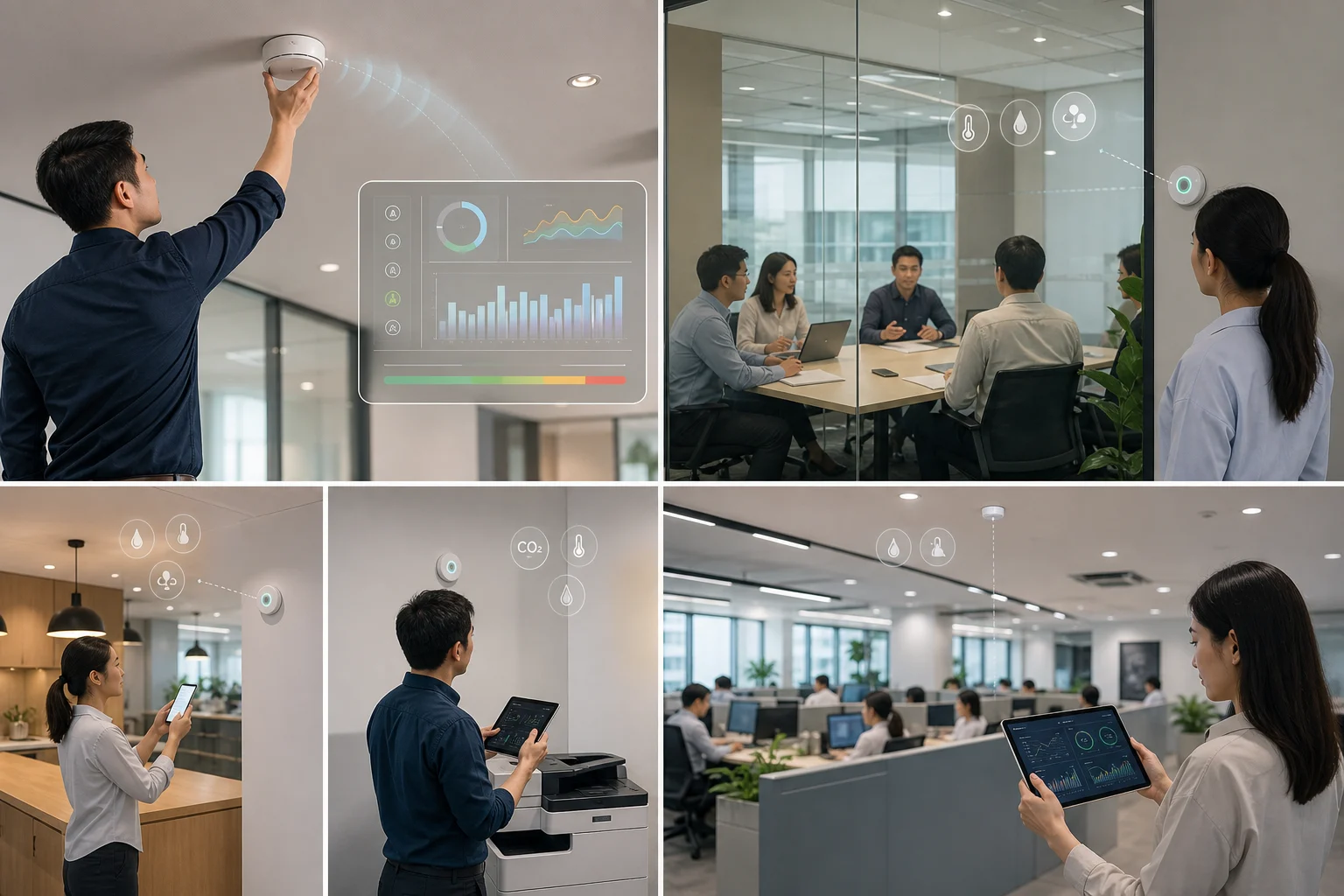
Facility teams identify high-occupancy rooms, enclosed spaces, pantries, printing zones, parking-linked areas, service zones, and spaces with repeated complaints.
Once the zones have been determined, sensors are installed appropriately. These sensors monitor data constantly and transmit it to the dashboard.
The facility manager can receive live updates, set threshold values, be alerted, and review past report data.
1. System Setup: The system has to be intuitive for facility personnel to use.
2. Relevant Alerts: The alert has to notify facility staff of what happened, where it happened, and what needs to be addressed.
3. Trend Review: While one set of data is useful, consistent trends prove even more important.
How Can Workplace Air Monitoring Support Compliance and Reporting?
Tenants, auditors, leadership teams, and certification bodies increasingly expect measurable data around workplace wellness, sustainability, and indoor environmental quality.
Workplace air monitoring helps create that record.
1. Green Documentation
Timestamped air quality data can support indoor environmental quality requirements for frameworks such as LEED or IGBC (Indian Green Building Council).
2. ESG Reporting
Organizations can support workplace wellness and sustainability claims with measurable indoor air quality data.
3. Review Readiness
Historical reports help facility teams show what was measured, when it changed, where it happened, and how the building responded.
This makes air quality easier to discuss during audits, tenant conversations, and internal reviews.
How Do You Choose a Workplace Air Monitoring System That Fits Your Workplace?
The right system should match the building’s real operating conditions. A long feature list is useful only if it solves the actual problem.
Start with your facility layout, usage patterns, and risk zones. Then evaluate the system.
1. Check parameter coverage: The system should track particles, gases, ventilation indicators, temperature, humidity, and noise.
2. Review dashboard clarity: Facility teams should be able to read the dashboard without needing complex interpretation.
3. Look for flexible thresholds: Different zones need different limits. A pantry, boardroom, basement, and open office cannot be managed with the same assumptions.
4. Confirm BMS compatibility: If automated response matters, the system should connect with existing building systems.
5. Plan for scale: A system used on one floor today should be able to expand across multiple floors, branches, or buildings later.
How AastroTech Helps?
1. Clear Air Quality Visibility
Get a clearer view of indoor air conditions, so facility teams can identify concerns early and make better decisions.
2. Facility Response Speed Increase
Provide support for faster responses to changes in air quality levels, contributing to comfort, safety, and facility management.
3. Work Environment Improvement
Provide conditions within buildings that support employee health and overall workplace improvement.
4. Facility Management Integration
Integrate IAQ into a smart facility management system along with lighting, visitor management, and integrated building management.
Where Does This Leave You?
Begin by identifying regions where air quality needs improvement, whether due to higher occupancy, pollutant accumulation, or recurring complaints. After that, find a workplace air monitoring system that provides your organization with access to important data and informative reports.
One cannot judge air quality by how spotless the room is or how chilly the air conditioning is. The true status of air quality hides in the data.
Ready to better understand your workplace air?
FAQs:
1. Why do organizations need to conduct monitoring of indoor air quality even if the office looks spotless?
A spotless office environment doesn’t necessarily mean the air inside is of good quality. Indoor air quality problems could be due to many reasons like bad ventilation, irregular recycling of fresh air through HVAC system, bad maintenance of cafeteria and the garbage management, close proximity of polluted spaces like higher vehicle traffic etc.
2. Does routine HVAC maintenance suffice to manage indoor air quality?
Routine HVAC maintenance is necessary; however, it does not allow for real-time insight into air quality in occupied areas. Work-area air monitoring enables organizations to understand the air quality in their work areas.
3. Why might certain meeting rooms be uncomfortable even with air conditioning?
The function of air conditioning includes regulating temperature; however, this does not mean that ventilation problems or poor air quality will be solved. Meeting rooms can be uncomfortable due to a high number of people, inadequate airflow, CO2 accumulation, excessive humidity, or indoor pollution.
4. Can air monitoring at work aid employers in solving recurrent problems from their employees?
Yes. When there are recurrent employee complaints of headaches, drowsiness, smell, irritation, and lack of concentration, air monitoring can help determine the cause.
5. Should organizations focus on monitoring the whole building or particular zones at first?
Organizations could start with high-frequency or high-risk areas, such as meeting rooms, cabins, pantries, basements, reception areas, and open-office environments. Monitoring the zones will help facility management identify potential issues related to air quality.
6. Which kinds of air quality data can be monitored by companies?
Data that can be monitored in the workplace through air quality monitoring systems include, but are not limited to, particulate matter, gases, temperature, humidity, ventilation, noise, and other parameters.
7. Can air monitoring data collected at work premises be used for audits or tenant review purposes?
Yes, since air quality data can always be stored and timestamped for audit purposes as well as tenant review processes.
8. What assistance does AastroTech provide to organizations for implementing workplace air monitoring?
AastroTech assists organizations in selecting the appropriate workplace air monitoring setup, taking into account facility layout, usage patterns, monitoring needs, and reporting requirements.
9. Can the AastroTech IAQ solution integrate with pre-existing building infrastructure?
Yes. The AastroTech IAQ solution can be incorporated into a smart building ecosystem that supports business needs for integrating air quality data with overall building processes.
10. Why is air monitoring in the workplace advantageous to facility managers?
Air monitoring in the workplace provides facility managers with better visibility, improved response times, more documentation, and enhanced control over the workplace environment.
