

Parking Guidance Systems: A Complete Guide from Entry to Exit
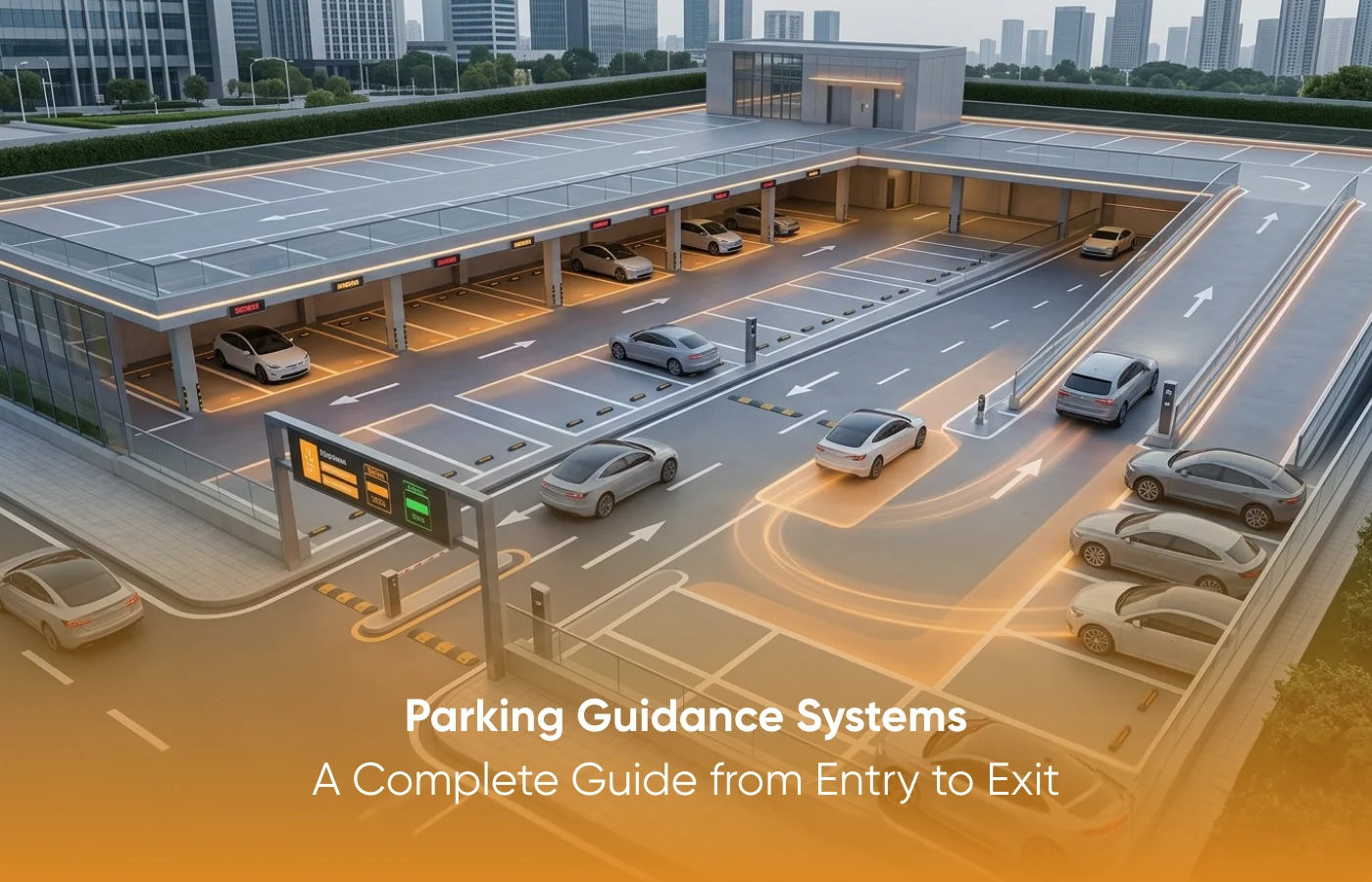
Why Parking Is a Bigger Operational Problem Than It Appears
Parking rarely gets the same attention as a building’s security or energy systems, but its impact on daily operations is significant. During peak hours, an unmanaged car park creates a cascade of problems: vehicles circling for available spaces, internal lanes congested, visitors arriving late and frustrated, and facility staff fielding complaints they have no real tools to address.
That same ten-minute search represents wasted fuel, unnecessary emissions, and avoidable congestion, all of which compound at scale.
A parking guidance system solves these problems at the source by giving both drivers and operators access to the same real-time information. Drivers know where to go. Operators know what is happening. The result is a parking operation that is faster, better distributed, and measurably more efficient.
How Does a Parking Guidance System Work?
A Smart parking management system consists of three different components that work together to enable the smooth flow of information regarding the parking space availability from the parking lot to the driver as well as the operator.
1. Entry Detection and Count Management
When a vehicle enters the facility, entry sensors register its arrival and update the real-time total occupancy count. This triggers directional guidance across the facility, ensuring that incoming drivers are immediately steered toward available zones rather than left to find their way independently.
2. Variable Message Signs (VMS)
Digital signs installed at decision points, such as the entrance of the ramp as well as the parking zone, display real-time parking space availability for the respective parking level or zone. A driver approaching a junction is able to see in real time whether there is a parking space available on the level above the parking lot, thus enabling the driver to make the decision before reaching the junction.
3. Per-Space LED Indicators
Each individual space is fitted with a sensor-connected LED indicator. Green signals an available space; red signals an occupied one. Drivers can see at a glance which spaces are free from the end of a row, removing the need to drive slowly past each bay checking for occupancy.
4. Real-Time Occupancy Updates
The moment a vehicle pulls into space, the sensor registers the change and updates the system instantly. Availability counts on the variable message signs, which adjust accordingly. There is no lag between space being taken and the information reaching other drivers in the facility.
5. Vehicle Location Recording
Some deployments include temporary vehicle location logging, which supports features such as find-my-car assistance at payment kiosks and validates parking duration for ticketed facilities. This data is held for operational purposes and cleared on exit.
6. Exit Clearance and Space Reset
When a vehicle leaves space and clears the sensor’s detection range, the space is automatically marked available, and the updated count is pushed to the relevant signs. The process is continuous and requires no manual operation from facility staff.
How Does a Parking Guidance System Improve the Driver Experience?
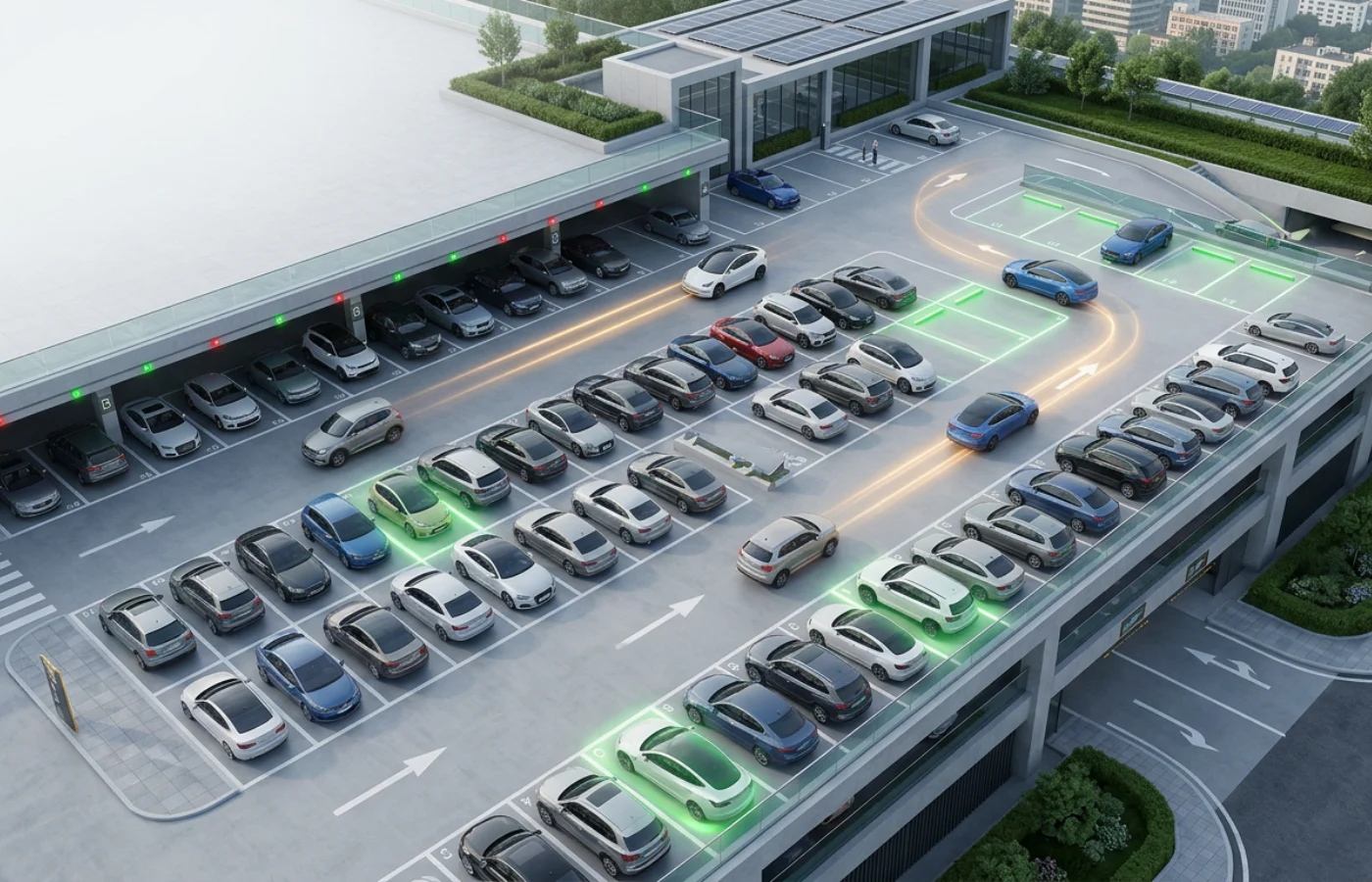
These factors are the time spent, the level of clarity, and the effort involved. A Parking guidance system addresses all these factors at once.
1. Less Time Searching
In a multi-level car park, a driver may need to drive around several levels in search of a parking space if there is no parking guidance system in place. However, a driver is taken to a level where there is a space at the entrance and then taken directly to the space by the time he/she reaches that level. The first and most obvious advantage is the amount of time saved.
2. Confidence at Arrival
Showing the number of available spaces at the entrance eliminates the fear that there might be none in a given parking lot or garage. The biggest advantage is experienced by a driver, especially if it is the first time he/she is visiting a given place, because in a busy city, the fear is real, and the chances of arriving at a packed lot are significant.
3. Clearer Navigation Inside the Facility
Multi-level parking garages are, by their very nature, confusing. Variable message signs at all critical points mean that drivers are never without the information they need before they need to make a turn. This eliminates the guesswork that can cause congestion, incorrect turns, and drivers who block lanes of traffic as they debate what to do.
4. A More Regular Routine for Regular Users
For employees, tenants, or users of a parking facility who use the parking facility on a daily basis, the guidance system can give a sense of predictability. Over time, users of the parking facility will come to trust the accuracy of the guidance system, and the parking process becomes a predictable element of their routine.
How Does a Parking Guidance System Help Facility Operators?
From an operational perspective, a parking system changes a car park that is hard to monitor into one that is completely visible and measurable. All aspects of a car park’s occupancy can be tracked and measured in real-time.
1. Real-Time Tracking of Car Park Occupancy
Every aspect of a car park’s occupancy can be tracked and measured in real-time. This means that car park operators can monitor how many car park spaces are occupied at any given time and can track these by levels, zones, or types of bays, such as reserved bays, accessible bays, and visitor bays.
2. Balanced Traffic Flow
Without a smart parking system, drivers will naturally park their vehicles in the closest or most accessible part of a car park. This leads to a situation wherein certain parts of a car park are overutilized, while other parts are underutilized. Drivers are directed to park their vehicles in parts of the car park that are not yet saturated, thus making full utilization of the car park before a particular part of it is saturated.
3. Data-Driven Planning
The system tracks occupancies over time, producing a body of data that is actually useful for planning. Facility managers can see which areas are consistently busy during peak times, which areas are underperforming, and what needs improvement in the layout or signage. The data can be used to determine whether to expand or whether to optimize the allocation of existing space.
4. Optimized Staffing and Resource Allocation
By using peak hour occupancies, facility operators can optimize staffing according to need rather than estimate. Security personnel, attendants, and maintenance personnel can be deployed to where they are needed most and when they are needed most.
How Do Parking Guidance Systems Contribute to Sustainability?
The environmental case for parking systems is clear: less time circulating results in less fuel burned and fewer emissions generated inside an enclosed or densely used space. But the sustainability profits extend beyond the obvious.
1. Reduced Fuel Consumption and Emissions
Every minute a vehicle spends searching for a space is a minute of unnecessary idling or slow movement. In a large facility with hundreds of vehicles during a busy period, the aggregate fuel consumption from search behaviour is significant. Directing drivers to available spaces immediately cuts this waste at the source.
2. Greater Equitable Use of Available Space
When all zones of a facility are utilised proportionally, peak congestion in high-traffic areas is reduced without expanding the physical footprint of the facility. This is a more eco-friendly outcome than building additional capacity to compensate for the poor distribution of existing space.
3. Informed Infrastructure Investment
Historical occupancy data gives facility planners an evidence base for infrastructure decisions. Rather than assuming that a facility needs expansion because selected zones feel crowded, operators can use data to determine whether the problem is a distribution issue solvable through better guidance, as well as a genuine capacity constraint.
What Should Organizations Consider Before Installing a Smart Parking System?
1. Infrastructural Compatibility
The infrastructural composition of the facility, including the height of the ceiling, wiring routes, and availability, plays a key role in determining whether or not to use a particular technology and at what cost to the facility. The infrastructural survey is one of the primary stages before any technology is chosen.
2. Technology Selection
The technology used in the facility may vary in terms of sensor type, including ultrasonic, infrared, camera-based, and magnetic sensors with different accuracy and cost factors.
3. Integration Requirements
The smart parking would be extremely useful if it were integrated with other infrastructural components in the facility, including access control, ticketing, payment, and monitoring systems. Integration compatibility should be considered before any particular technology is chosen.
4. Return on Investment
The business case for a Parking guidance system is usually based on lower congestion, improved user experience, lower staffing costs, and data to inform better long-term planning. Quantifying these benefits versus costs of installation and maintenance is important to justify the investment.
5. Implementation
For large and/or complex facilities, a staged implementation approach can begin in the highest-congested zones first. This permits immediate benefits while keeping ongoing facility operations to a minimum during installation.
How AastroTech Delivers Parking Guidance System Implementations
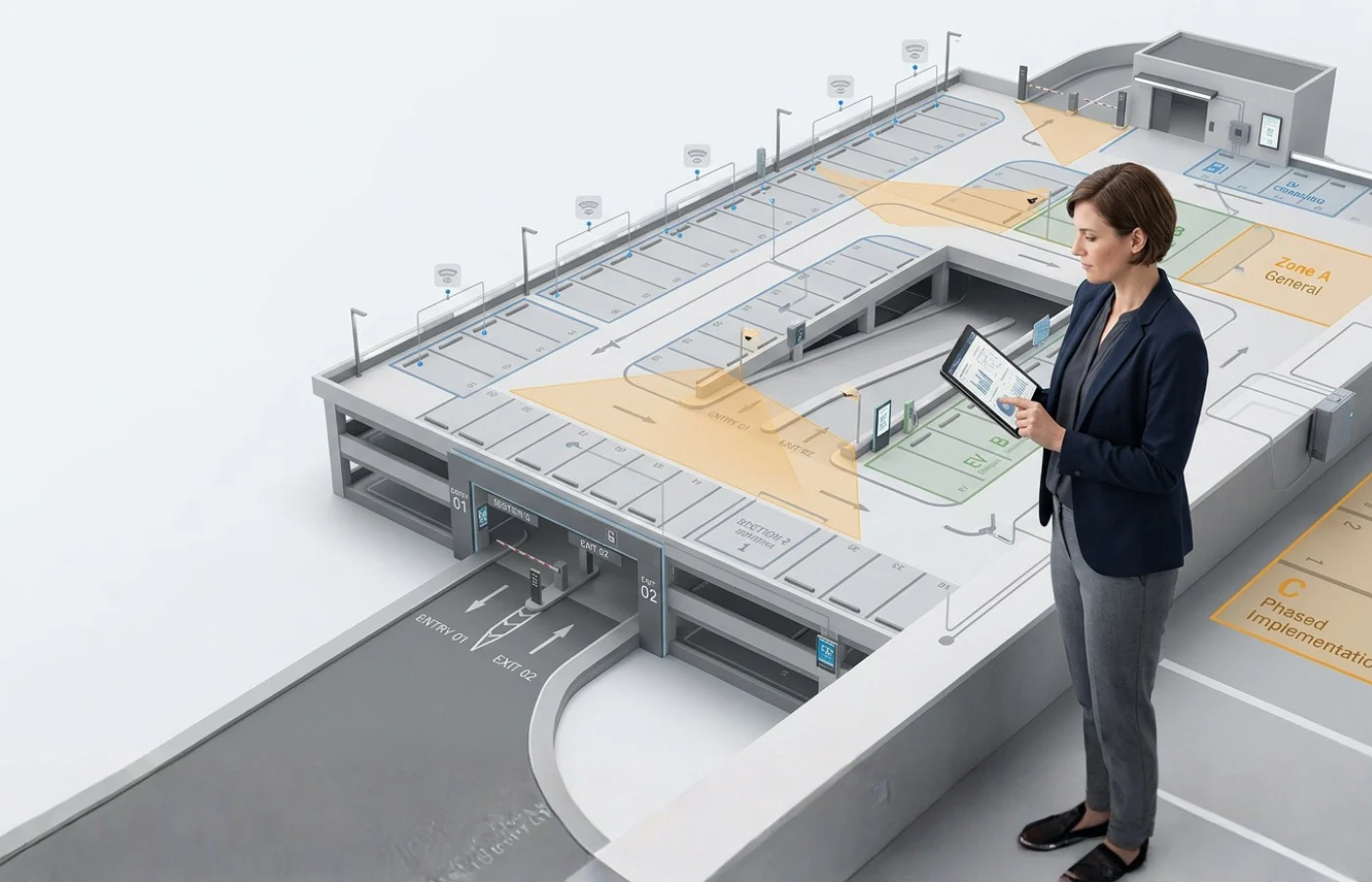
AastroTech adopts an extremely customized approach to every parking guidance system installation, starting with an assessment of the flow of traffic and parking layout prior to the selection of hardware and software.
The implementation process for AastroTech includes site assessment, selection of sensors and displays, staged implementation to minimize disruption to facility activities, and integration of the parking system with existing access control and monitoring equipment. After the implementation, the system is constantly monitored and fine-tuned to safeguard the accuracy and validity of detection and occupancy.
The emphasis throughout is on long-term functionality. A parking guidance system is not a one-time installation, and it is not a product that is simply installed and left to itself. It needs periodic calibration, review, and adjustment to respond to changing facility needs, and AastroTech’s service model is designed with that in mind.
For facility managers evaluating a smart parking system, the right starting point is a clear assessment of the specific problems the facility currently experiences, whether that is peak-hour congestion, uneven zone utilisation, limited operator visibility, or a combination of all three. From there, a methodical evaluation of technology options against those specific needs will identify the most effective solution.
Conclusion:
A parking guidance system is a piece of infrastructure that, in and of itself, justifies its cost because it solves so many problems, such as wasted search times, internal congestion, space utilization, and operational blind spots that come with managing a large facility without live data.
Although the benefits to a driver are instant and substantial, arriving quicker, driving more easily, and no longer being concerned about parking, the benefits to a facility are profound and structural: every space is now visible, every pattern is now measurable, and every planning decision is now informed rather than merely speculative.
Partner with AastroTech to bring structured parking intelligence to your facility.
FAQs:
1. What does a parking guidance system do, and how does it work?
A parking guidance system uses sensors to detect whether each space in a facility is occupied or available. That information is displayed on LED indicators at individual spaces and on digital signboards at key navigation points. Drivers are guided toward available spaces from the moment they enter the facility, without needing to search manually.
2. How does a parking guidance system improve operating efficiency?
By directing vehicles to available spaces immediately, the system reduces the amount of time each vehicle spends inside the facility searching. This lowers internal traffic volume during peak periods, reduces congestion in high-demand zones, and frees up operator attention from managing flow manually.
3. Can parking guidance systems be installed in outdoor facilities?
Yes. Sensors, network components, and display units can all be specified for outdoor deployment, accounting for weather exposure, temperature variation, and ambient light conditions. The core functionality remains the same the hardware is simply selected and configured for the external environment.
4. How long does a typical Parking guidance system installation take?
Installation timelines vary based on facility size, complexity, and the extent of integration required with current systems. Most deployments are structured in phases infrastructure first, then hardware, then testing and calibration to minimize disruption to facility operaions during the rollout.
5. Can smart parking integrate with access control and payment systems?
Yes. Integration with access control, ticketing, and payment platforms is a standard capability of most modern PGS deployments. This creates a unified management environment where entry data, occupancy figures, and payment records are all connected and accessible from a single dashboard.
6. Are these systems suitable for multi-level facilities?
Multi-level facilities are among the most common use cases for parking guidance systems. The system provides level-by-level occupancy data and directional guidance at each ramp or transition, ensuring drivers have accurate information before committing to a specific floor.
7. How does AastroTech customize a parking guidance system for a specific facility?
AastroTech begins each project with a traffic flow analysis and layout assessment. Sensor types, display configurations, and integration requirements are then selected based on the facility’s specific characteristics and functional priorities. This ensures the system is designed for the facility as it actually operates, not as a standard configuration.
8. What ongoing support is required after installation?
Parking guidance systems require periodic calibration and performance review to maintain detection accuracy over time. Sensor drift, physical changes to the facility, and evolving usage patterns can all affect system performance if left unaddressed. A structured maintenance and monitoring programme ensures the system continues to deliver reliable data throughout its working life.
9. Can the system's occupancy data be used for longer-term planning?
Yes. Historical occupancy data is one of the most practical outputs of a parking guidance system. Facility managers can use it to identify consistent peak periods, understand how different zones are utilised relative to each other, and make infrastructure and staffing decisions grounded in actual usage patterns rather than estimates.
10. What ongoing support can be associated with these Systems?
Smart parking requires periodic monitoring, calibration, and performance review to maintain detection accuracy and system consistency over time.
