

Why RFID Tags for Asset Tracking Are Becoming Essential in Modern Organizations
Most organizations don’t lose assets because people steal them or because things vanish overnight. They lose visibility slowly.
A tool is moved from one floor to another. A device is shifted for repair and never mapped back into the system. A crate is sent out for a site job and returns weeks later without any documentation. Audits become stressful, not because assets are missing, but because teams cannot confidently prove where things are, who last used them, or whether they are still in service.
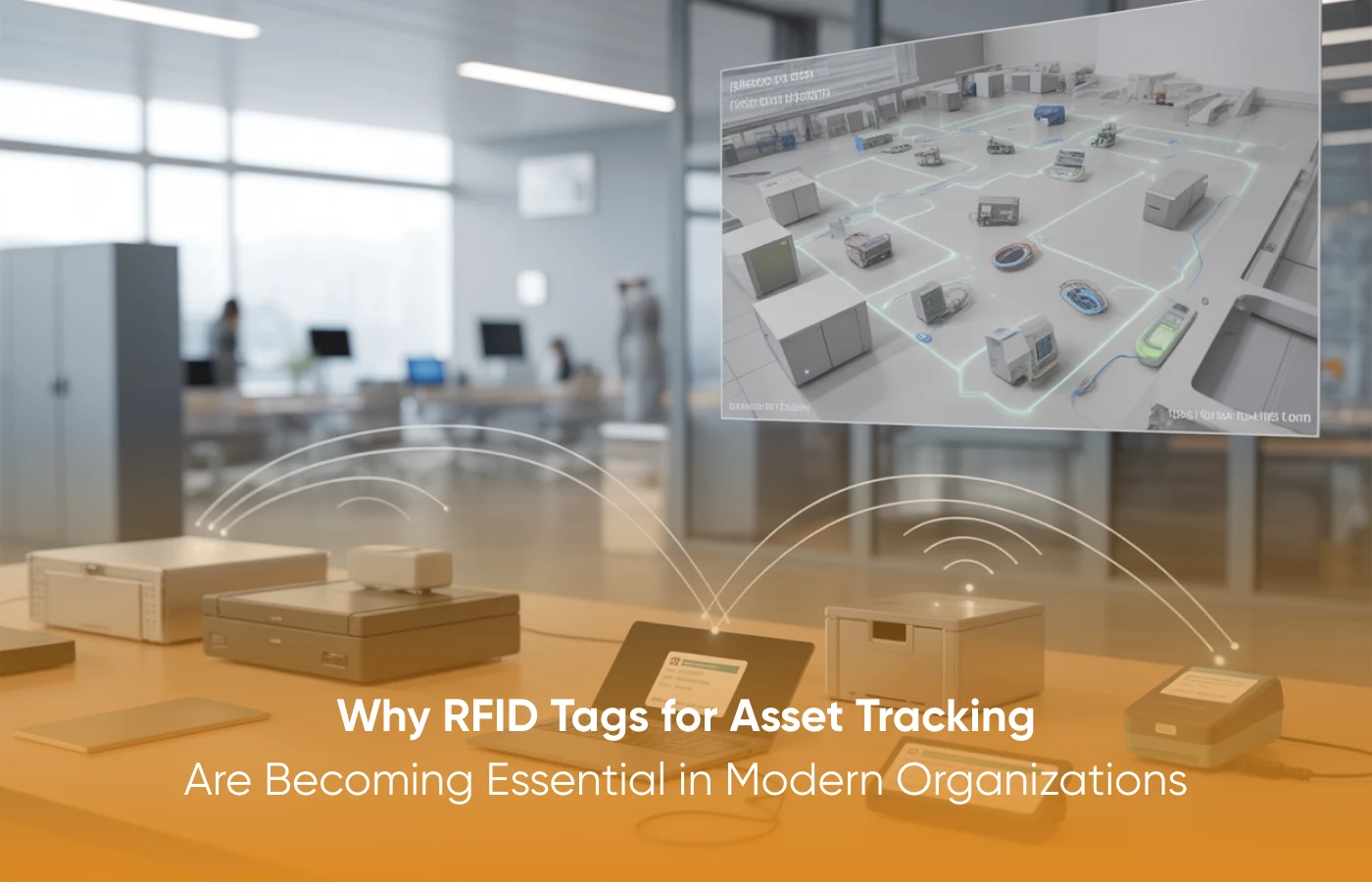
This is exactly why RFID tags for asset tracking are becoming essential in modern organisations. especially when supported by a structured RFID Asset Tracking System. As asset volumes grow and movement becomes constant, manual tracking methods struggle to keep up. RFID changes the equation by enabling automatic identification and faster asset validation, even when assets are stored densely, shared across teams, or moved frequently across locations.
Key Benefits of RFID Tags for Asset Tracking
RFID tags help modern organizations improve asset visibility and control at scale. When deployed correctly, they deliver measurable operational benefits:
• Faster audits and cycle counts by enabling bulk identification without manual scanning
• Higher inventory accuracy across departments, sites, and shared asset pools
• Reduced asset loss and misplacement through consistent identity tracking over time
• Improved compliance and governance with stronger audit trails and cleaner asset registers
• Lower operational effort by reducing manual reconciliation and dependency on human-led tracking
• Better lifecycle management by linking physical assets to depreciation, maintenance, and movement history
How RFID Tags Work: Technical Basics for Asset Tracking
At its core, RFID asset tracking connects physical objects to digital records using radio frequency communication. Each tag carries a unique identifier. When an RFID reader detects the tag, the asset can be recognised and logged without requiring line-of-sight scanning.
That difference is what makes RFID so valuable in real environments. Unlike barcode systems where someone must physically locate the label and scan it, RFID allows assets to be detected even when they are inside drawers, stacked in storage, or moving through a defined area such as a doorway or staging point. When the system is designed well, asset detection starts happening in the background rather than depending on consistent human effort.
Why Procurement Teams Are Prioritising RFID Now
Procurement doesn’t only purchase assets anymore; it is increasingly accountable for asset governance. In many organisations, procurement must support audits, justify replacements, explain mismatched registers, and track assets across departments.
This is where RFID creates measurable value.
As organizations scale, asset tracking becomes less about what you bought and more about what you can prove you still own, where it is, and whether it is in use. RFID improves this visibility because the tag identity remains consistent across movement, storage, and audits. It reduces the pressure of manual reconciliation and significantly lowers errors caused by missed entries, delayed updates, or incomplete scanning.
However, RFID is only reliable when tag selection matches the physical environment. Procurement teams that choose tags based only on generic specifications often face re-tagging cycles later. Long-term reliability depends on surface compatibility, antenna performance, mounting location, and real-world read behaviour.
How RFID Tags Work in Practical Hardware Terms
RFID tags are not complicated devices, but they are sensitive to environment and placement.
A typical RFID tag includes a microchip (which stores the unique ID), an antenna (which transmits it), a substrate (which provides structure), and a protective outer layer that shields the tag from wear and environmental exposure. In most asset tracking deployments, organizations use passive RFID tags. These tags do not have a battery; the reader powers them momentarily and the tag responds with its identifier through backscatter communication.
This is why passive RFID works well for enterprise-scale tagging. It is low maintenance, cost-effective, and suitable for large asset volumes. But it also means performance depends heavily on antenna design and how the tag is mounted. A tag with strong housing and well-matched antenna geometry often performs more consistently than a tag with higher memory or additional features.
Why RFID Performance Varies in Real Environments
RFID success is not decided in a lab. It is decided on the floor.
The same tag can work perfectly in one location and struggle in another. Metal surfaces can interfere with signals, liquids can absorb or distort frequency behaviour, and dense storage layouts can create inconsistent read zones. This is why RFID projects fail when organizations assume RFID behaves like a universal “plug-and-play” solution.
In warehouses, RFID can dramatically speed up cycle counts and improve location detection for inventory and handling equipment. In logistics workflows, it can support faster inbound and outbound movement tracking. In IT and facilities, it improves audit trails and strengthens asset governance for compliance and depreciation. In healthcare operations, RFID helps track equipment availability inside controlled zones like labs and clinical support environments, where accountability matters and delays cost time.
In all these environments, RFID delivers value only when the system is designed around how assets actually move.

What Makes RFID Tracking Reliable, Not Just “Installed”
The highest-performing RFID asset tracking systems are built on discipline and design, not just tag purchase.
Tag strategy is the first foundation. Standardizing tags for common assets helps organisations scale faster, while specialised tags are reserved for difficult surfaces like metal, harsh environments, or high-temperature exposure. Placement discipline is the second foundation. When tags are mounted randomly across similar assets, read accuracy becomes inconsistent and system tuning becomes difficult. But when mounting positions and orientation are standardised, RFID capture becomes repeatable.
The third foundation is read-zone planning. Reliable RFID systems do not rely on “reading everything everywhere.” Instead, they define zones where reads must occur consistently, such as storage areas, choke points, maintenance rooms, and process transition zones. The final foundation is field validation. Pilots are not optional; they are how organisations confirm read behaviour under real movement, real mounting, and real operational load.
A successful pilot prevents expensive rollout mistakes.
RFID Tag Selection Guide: Passive vs Active vs Battery-Assisted
Most RFID selection decisions come down to three things: range, durability, and environment fit.
Passive tags are ideal for high-volume assets where low maintenance and long service life matter. Active tags use battery power to provide longer read ranges and support real-time tracking in movement-heavy scenarios, but they add battery maintenance and cost. Battery-assisted passive tags sit between these models and can improve sensitivity in complex RF environments while retaining passive workflows.
Frequency selection also matters. Low-frequency tags work reliably at short range and tolerate liquids and metal-heavy environments better. High-frequency tags offer controlled range and are often used where NFC compatibility matters. Ultra-high frequency tags are widely used for fast multi-tag reading and longer range, making them suitable for warehouses and logistics-heavy operations.
Finally, form factor determines tag survival. Label tags work well for cartons and clean surfaces but fail in rugged environments. Hard tags and rugged enclosures are designed for reuse, frequent handling, and harsh conditions. On-metal tags are essential where conductive surfaces would otherwise kill performance.
The best RFID deployments treat tag selection as an engineering decision, not a catalog decision.
RFID vs Barcode: The Real Difference in Daily Workflows
Barcode tracking systems depend on people doing the right thing every time. Someone must locate the label, scan it correctly, and log movement without skipping steps.
In short, barcodes work best when processes are controlled. RFID works best when processes are fast, shared, and movement-heavy.

What ROI Looks Like When RFID Is Done Right
RFID delivers the clearest value in environments where assets are shared, audits are frequent, and movement is constant. Tool rooms, spare part cages, staging areas, and return loops are good examples. IT asset governance is another high-impact area because compliance-driven environments require repeatable auditing and accurate registers.
Over time, the value shows up in faster cycle counts, fewer unknown asset locations, reduced reconciliation effort, and higher data integrity across systems. This is not just operational convenience. It strengthens governance, planning accuracy, and cost control across the enterprise.
How AastroTech Supports RFID Asset Tracking Deployments
AastroTech approaches RFID as a complete system capability, not simply a tag recommendation.
Their process begins with understanding asset behaviour, physical conditions, and real movement patterns, then mapping those realities into tagging standards, read zones, and integration models. Clients are supported through asset classification, pilot testing, reader placement, zone planning, and integration with existing asset management platforms.
This reduces guesswork, prevents repeated re-tagging, and ensures RFID performance remains stable as asset volumes and locations grow.
Conclusion
RFID asset tracking works best when the technology is implemented to match reality: how assets move, how they are handled, and where they spend most of their lifecycle.
When RFID is treated as a system including tag selection, placement rules, read-zone planning, and real-world validation it becomes one of the most dependable ways to strengthen asset governance at scale. For organizations moving away from manual tracking and inconsistent registers, RFID is no longer an experiment. It is a foundational upgrade.
If you want to explore RFID tagging in your facility, the best next step is a pilot that uses real assets, real workflows, and measurable outcomes. That is where visibility becomes reliable, and tracking becomes effortless.
Reach out to us at info@aastroelectronics.com to learn all about how IoT can help your organization.
FAQs:
1. When should an organization start considering RFID Tags for Asset Tracking?
Organizations typically begin exploring RFID when asset audits take too long, inventory accuracy drops, or assets move frequently across teams and locations. This stage often follows repeated reconciliation issues or growing compliance and reporting pressure.
2. What information should be gathered before evaluating RFID Tags for Asset Tracking?
Teams should document asset types, materials, movement patterns, environments, and audit frequency. A clear understanding of where assets live and how they move ensures tag selection aligns with real operating conditions rather than assumptions.
3. How do organizations decide which RFID Tags for Asset Tracking are suitable?
Selection depends on asset surface, required read range, exposure to metal or liquids, and lifecycle expectations. Shortlisting happens after matching tag type, frequency, and form factor to each asset category.
4. Why is pilot testing critical before finalizing RFID Tags for Asset Tracking?
Pilot testing validates tag performance on real assets in live conditions. It helps confirm read reliability, mounting methods, and zone coverage before procurement commits to volume orders or standardization.
5. How does integration typically work after RFID Tags for Asset Tracking are selected?
Once tags are validated, they are integrated with readers and asset management platforms. Asset IDs are mapped to digital records, enabling automated audits, movement tracking, and reporting without changing existing workflows.
6. What challenges usually appear during early RFID Tags for Asset Tracking deployments?
Early challenges often relate to tag placement, orientation, or environmental interference rather than hardware faults. Fine-tuning mounting positions and read zones resolves most performance inconsistencies.
7. How do organizations scale RFID Tags for Asset Tracking across multiple sites?
Scaling requires standardizing tag types, placement rules, and naming conventions. Consistent deployment practices ensure assets remain identifiable as they move between locations and systems.
8. How do organizations measure long-term value from RFID Tags for Asset Tracking?
Long-term value is measured through reduced audit time, improved asset accuracy, fewer losses, and better lifecycle visibility. Stable tag performance supports governance, compliance, and planning over time.
