
Sound Masking System: A Smarter Way to Reduce Office Distractions
What is a Sound Masking System?
Creating a conducive work environment is paramount in today’s bustling corporate world. One critical aspect often overlooked is sound management. This is where sound masking system for office come into play, revolutionizing how businesses address acoustic challenges in office spaces.
In this blog we will discuss what is sound masking system and how it is different from white noise, a sound signal used to mask other sounds.
In high-focus environments, the brain is always on, picking up every sound, decoding every whisper, and burning energy on distractions that don’t deserve the attention. This constant mental filtering drains productivity and leaves employees more fatigued than fulfilled.
But what if sound could be tuned to support focus instead of fighting it?
That’s where sound masking technology steps in, introducing a subtle layer of ambient sound that helps neutralize distractions, protect speech privacy, and restore acoustic harmony.
In this blog, we dive into how it works and why it’s becoming the silent hero of smart workspace design.
Why Office Noise Affects Performance
Even when workers are visually attending to a screen, their ears stay attentive to all sounds in the vicinity. The brain tends to process speech automatically even when it is irrelevant that consumes mental space and disrupts focus.
This is particularly significant in open offices, where there is minimal segmentation of work areas. Sound masking technology reduces these interferences by generating a homogeneous ambient sound that discourages the brain from attaching itself to distracting noise.
How Sound Masking Technology Works
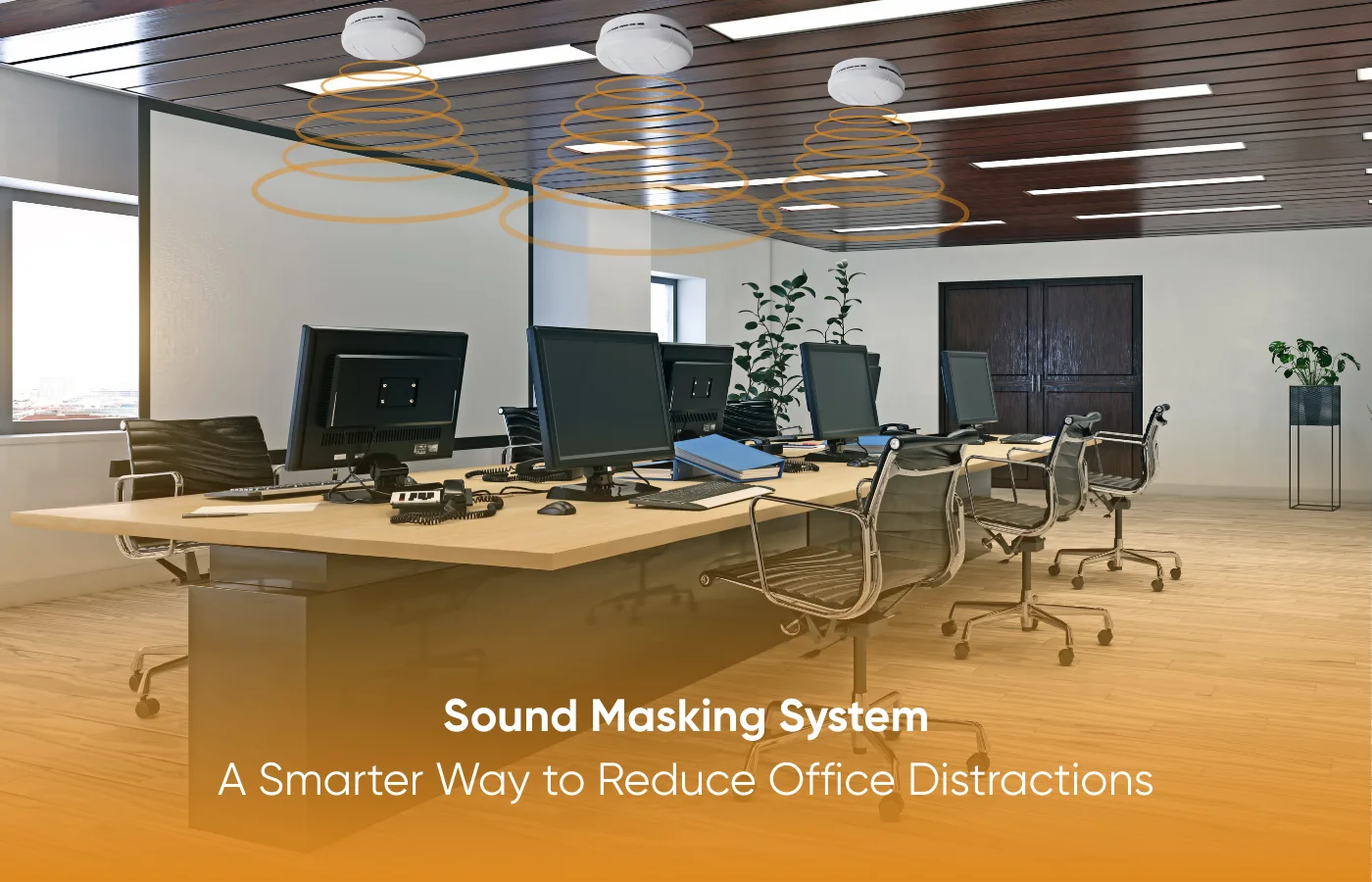
They install sound masking technology in the ceiling so that the created sounds move upward and bounce off surfaces to fill a room quite equally. The sounds produced are hardly noticeable, meaningless, and so random that it becomes silent and will not draw attention to itself.
This creates a “sound curtain” that makes conversations hard to hear beyond a certain distance in open workspaces or shared facilities. The innovation relies on introducing sound, causing less interruption to the current noise without necessarily making the space louder.
How Sound Affects the Brain
Disruptive noise impacts beyond hearing. It raises the level of cortisol, the stress hormone, with increased cortisol capable of damaging the prefrontal cortex, which is responsible for memory, logic, and choice.
Over time, unchecked noise can help decrease dopamine. This can yield low motivation and energy, which can lead to a decline in engagement, mood fluctuations, and reduced productivity. It restores the equation by offering a neutral sound that does not impede cognitive functioning.

Types of Sounds Used in Sound Masking Technology
1. White noise: Even across all frequencies, can feel sharp to the ear.
2. Pink noise: Softer and more balanced, similar to gentle rainfall.
3. Brown noise: Deeper and fuller, like the sound of distant thunder.
4. Black noise: Near silence, used in extremely quiet or controlled environments.
Each sound profile is selected based on the layout, size, and acoustic needs of the space.
Designing a Healthier Work Environment
The effects of sound are enhanced when combined with nature. Offices that incorporate plants, gentle light, and natural ambience in the decor are perceived as more calming. Introducing water-like ambient sound using pink or brown noise leads to quicker mental recovery and longer periods of concentration by employees.
It is incorporated as part of a bigger approach that makes employee comfort and well-being the central focus of office design.
Benefits of Sound Masking Technology
1. Reduced Diversion
The sound masking technology covers the background noise and any form of distraction that may disturb the employees. The constant ambient noise reduces mental fatigue caused by constant distractions.
2. Enhanced Speech Privacy
It is mostly used in meeting rooms, HR cabins, and in hospitals for conversation purposes where sensitive information is shared. It helps retain confidential data and ensures conversations are not overheard.
3. Employee Wellness Support
Chronic exposure to distracting noise elevates stress levels. Prolonged periods may result in low motivation and workplace discontentment. Control of the sound environment brings employees a sense of serenity and clarity.
4. Adapts Any Space
The sound masking technology can be installed either in a new building or existing facility and can always be reconfigured in case layouts change. This adapts with flexibility to the growing teams and hybrid office models.

Use Cases in Offices and Healthcare
In Offices
Open offices encourage collaboration but also make it more difficult to manage sound. Teams in such environments tend to grapple with constant distractions. Sound masking technology establish acoustic zones that enhance individual concentration as well as group discussion without structural boundaries.
In Hospitals
Staff communication and patient privacy are paramount in medical settings. Sound masking technology ensures confidential conversations are kept in rooms, waiting areas, and surgical departments. It also minimizes the noise effect of alarms, trolleys, and hallway traffic to create a more serene healing atmosphere.
Difference Between Speech Privacy Systems and Sound Masking System for offices
Although the two terms are often used interchangeably, they are not the same. Both improve acoustic comfort, but they do so in different ways and serve different purposes.
Purpose of Speech Privacy Systems
1. The primary goal is to prevent listeners from understanding conversations happening nearby.
2. It focuses on confidentiality, making speech unintelligible at a distance.
Purpose of Sound Masking System
1. The goal is to reduce distractions caused by background noise.
2. It creates a consistent ambient sound that helps people stay focused and feel more comfortable in open spaces.
How Speech Privacy System Works
1. Uses technology or design strategies (walls, ceiling tiles, special materials, electronic solutions) to block or reduce the clarity of speech.
2. Can include:
o Absorption (reducing reflections)
o Blocking (adding barriers)
o Covering (using sound masking as one component)
How Sound Masking System Works
1. Uses low-level, engineered sound—similar to airflow—distributed across a space.
2. The added ambient sound covers or blends with speech, making it harder to distinguish without feeling intrusive.
Scope of Speech Privacy Systems
1. A broader, multi-layered concept.
2. Sound masking is one part of a complete speech privacy strategy.
3. Often required in:
o Healthcare (HIPAA compliance)
o Finance offices
o HR and interview rooms
o Boardrooms
Scope of Sound Masking system
1. A specific technology used to improve acoustic comfort.
2. Works best in open-plan offices, co-working spaces, and call centers.
3. Cannot solve privacy problems alone if walls are thin or poorly insulated.
Outcome of Speech Privacy Systems
1. Ensures sensitive conversations cannot be overheard or understood.
2. Ideal for confidentiality and compliance.
Outcome of Sound Masking Systems for Offices
1. Reduces noise distractions.
2. Improves productivity, focus, and comfort.
3. Makes speech blend into the background rather than making it unintelligible from the start.
A Simple Analogy
1. Speech Privacy is the goal — keeping conversations private.
2. Sound Masking is one of the tools that helps achieve that goal.
In a Nutshell
Speech privacy is the desired outcome of preventing overheard conversations, while sound masking is a technology that adds background sound to improve comfort and help achieve partial speech privacy.
Conclusion:
At AastroTech, we recognize that acoustic discomfort is one of the most overlooked barriers to productivity. Our sound masking technology provides a practical and powerful solution, reducing distracting noise and improving overall sound quality. This helps employees concentrate better, feel more comfortable, and communicate with clarity.
For facilities and workspace managers looking to improve performance, privacy, and employee well-being, AastroTech’s sound masking system is a smart investment in a quieter, more focused work environment.
Contact AastroTech today for a customized sound masking solution.
FAQs:
How is sound masking different from white noise?
Sound masking is engineered to match human speech for privacy, while white noise is just generic audio loops.
2. Does sound masking make the office noisier?
No. It does not create the space louder, but rather provides ambient background noise that gets blended into the environment and serves to diminish the intelligibility of speech and distractions.
3. Can sound masking be installed in an existing office?
The system is indeed highly adaptable. It can be installed in new as well as existing spaces, including open offices, meeting rooms, and hospitals.
4. Is it safe for ongoing use?
Indeed. The background sound is low-level, inconspicuous, and engineered precisely to promote comfort without inducing harm or wear.
5. Where is it most useful?
It’s commonly used in open-plan offices, meeting rooms, HR departments, call centers, hospitals, waiting areas, and anywhere speech privacy or noise control is important.
6. Where is sound masking most effective?
It works best in open offices, meeting rooms, and healthcare spaces where speech privacy and reduced distractions are critical.
