
Hot desking is a popular and versatile concept of workspace arrangement within an organization enabling optimal workspace utilization. It allows employees to reserve a desk, meeting rooms, and other resources through a
Wayfinding Solutions for Complex Campus Environments
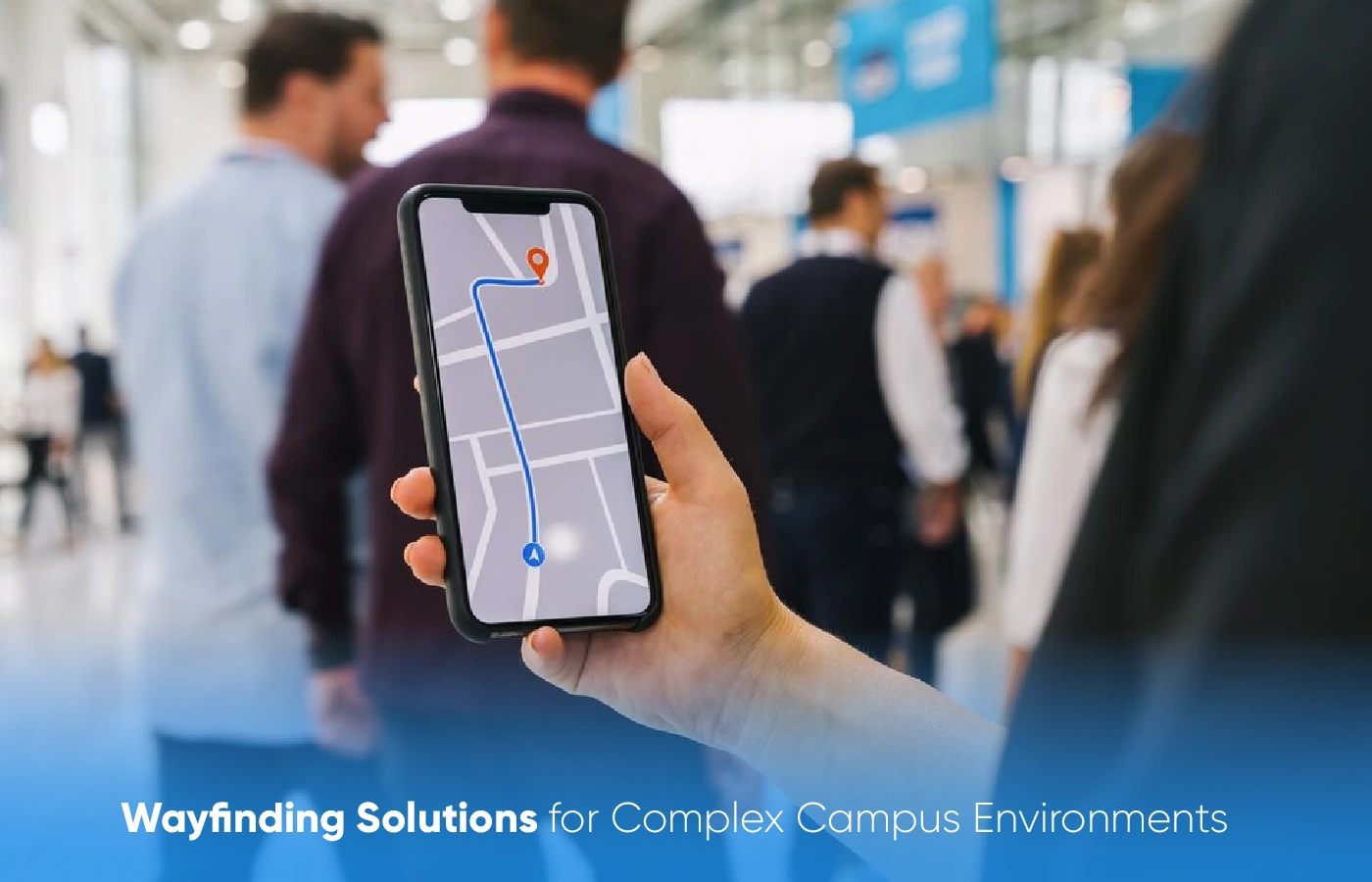
Wayfinding solutions help people find their way around large buildings or campuses without getting lost. Think of it as GPS for indoor spaces—using signs, digital maps, mobile apps, and smart sensors to guide employees, visitors, and staff exactly where they need to go.
Introduction
Wayfinding is a word coined by Kevin Lynch, an American urban planner and author, in 1960. In his book The Image of the City, Kevin Lynch used it to describe the concept of environmental legibility, the elements of the environment required to navigate through complex spaces.
What wayfinding solutions include:
Digital signage and interactive kiosks
Mobile apps with indoor maps
Beacons and indoor positioning systems
Integration with room booking and facility management
Real-time navigation and occupancy tracking
Current Context:
It refers to displays or signage that help people find their way through a complex commercial or public space. No one likes feeling lost, especially when trying to be productive or meet a potential new employer or business partner.
Organizations across the globe are leveraging technologies to develop more flexible, smarter, and better-connected workplaces. When navigating complex campus environments like corporate headquarters, implementing wayfinding solutions can help employees and visitors find their way efficiently. Here are some common strategies and technologies deployed for effective wayfinding.
Please read our blog on “Wayfinding: How to Stop People from Getting Lost!” to understand its fundamentals and how it works.
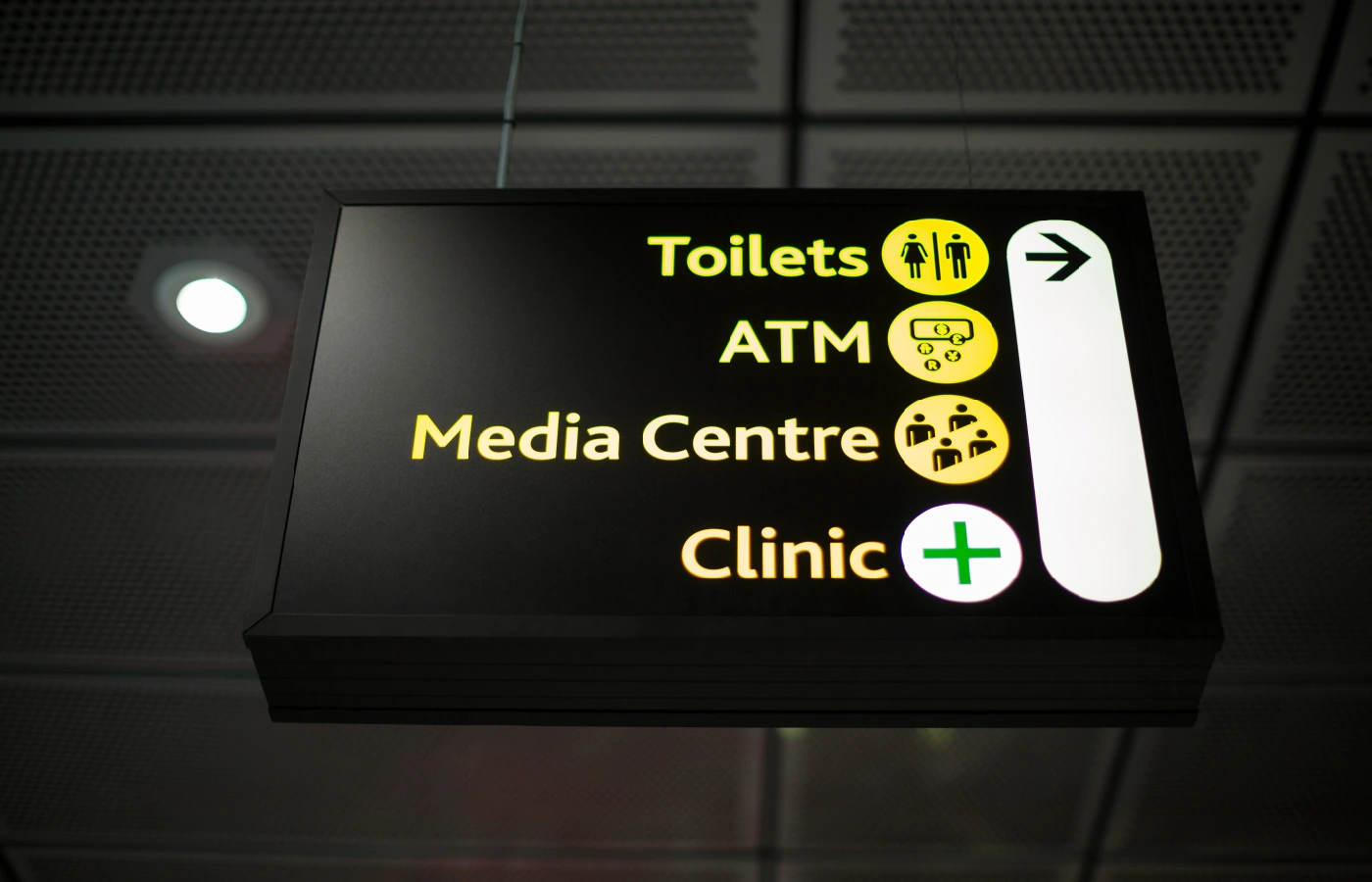
Wayfinding Signage
It refers to a system of strategically placed signs and visual cues that direct people to different locations within and around a building. They include typography, icons, directional arrows, and symbols.
What makes wayfinding solutions different from regular signage?
While regular signage simply points to locations, wayfinding solutions combine physical signs with digital tools, mobile apps, and smart technologies. Regular signs are static; they can’t update when a room is booked or guide you around a closed hallway. Wayfinding solutions adapt in real-time, integrate with building systems, and provide turn-by-turn navigation like GPS does outdoors.
Kiosks
Interactive kiosks provide a user-friendly interface, allowing individuals to navigate the building, locate floors, specific rooms, or departments, and access other relevant information.
Users can access detailed maps of the building, including floors and areas. They can pan across the map, select a location or point of interest, and receive directions from the current location.
While these are the basic functionalities of wayfinding devices, integrating various arrangements, such as workspace booking systems, has revolutionized the wayfinding solutions.
Integrated systems
The kiosks, web, or mobile app-based wayfinding solutions can be integrated with other facility management systems, such as room booking software, security systems, and calendars. Employees or higher management staff can check the availability of different working areas, such as desks, conference rooms, and meeting rooms.
Can wayfinding solutions integrate with existing building systems?
Yes, modern wayfinding solutions are designed to connect seamlessly with your existing infrastructure. The kiosks, web, or mobile app-based wayfinding solutions can be integrated with other facility management systems, such as room booking software, security systems, and calendars. This means your wayfinding system can show real-time room availability, update when meetings are extended, guide visitors through secure access points, and even trigger HVAC adjustments when people enter a space.
Based on the availability of the facilities for a particular day and time slot, they can book them. The system automatically updates the occupancy across the devices with access to the availability information. If the scheduled activity, event, or meeting overruns, the organizer can extend the booking slot as per requirement.
Automatic systems can be configured to free up the booked but unutilized space per the booking schedule. It allows effective space utilization by making it available for an employee needing the facility.
An option is to customize map views on wayfinding mobile apps for staff and the public. It allows tailoring different access levels to other user groups, such as visitors and employees. In addition to maps of the corporate complex, the interface for employees gives access to detailed office views, the availability of meeting rooms, and a booking system. In contrast, visitors can only access maps, search for locations of different amenities, and receive directions to the destination. Here is an illustration.
Planning to implement these integrated systems? Follow our step-by-step guide to building an effective office wayfinding system” for practical deployment strategies.
Integrated systems allow workspace and facility managers to efficiently schedule and implement maintenance activities. It also enables them to assess office space utilization and streamline resource allocation.
Beacons and indoor positioning systems
These are high-precision location tracking and navigation technologies for indoor environments where GPS may not be readily available or accurate. User devices, such as smartphones and tablets, detect the signals emitted by beacons and IPS.
Based on the signal characteristics, such as strength, users receive information on their distance from the location. By strategically installing multiple systems, this wayfinding solutions can notify users of their position within a building and give them directions via a compatible navigation application.
The remarkable benefits of beacons and indoor positioning systems are enhanced precision and proximity-based position tracking and interactions. It allows security personnel to monitor the movement of employees and visitors in restricted areas and send alerts to the connected devices close to the beacons and IPS.
These systems also allow integration with building automation systems, such as HVAC systems, to provide additional functionality. For example, lighting and temperature settings in a room can be automatically adjusted based on occupancy, leading to energy savings.
How can companies profit from wayfinding solutions?
- Brand recognition
Wayfinding signage can help present a strong visual identity of the business to visitors and clients, which can increase brand recognition. It can be achieved by designing them in the company’s style, color scheme and incorporating the brand logo and message. Thus, wayfinding solutions can also serve branding purposes.

- Improved client interaction
Every interaction is an opportunity to promote what the company is selling. A well-designed wayfinding solution can motivate clients to explore the office space and familiarize themselves with the company. A smooth navigation of people around the office and a relaxed vibe offer a subtle air of professionalism and sound practice to potential partners and investors. - Ease of workflow
Customized maps of complex buildings can assist cleaners and maintenance staff. They help create work routes for the day and locations of necessary tools and resources.
Even for contractors who are new to the company, wayfinding solutions can be generated and shared. They help them navigate through the areas where their service is required.
They help the service personnel reach their destination on time and deliver their work. Thus, it provides for business operations avoiding delays.
Thus, it enables business operations without delays.
Looking to implement wayfinding solutions in your campus? Contact us to explore tailored options for your space.
What ROI Can Companies Expect from Wayfinding Solutions?
Organizations implementing wayfinding solutions typically see returns in three key areas:
- Time savings:
Employees waste an average of 15-20 minutes daily navigating unfamiliar spaces. In a 500-person office, that’s 125+ hours lost per day. Wayfinding solutions reduce this by 60-80%, translating to thousands of productive hours recovered annually. - Visitor experience:
Companies report 40% improvement in visitor satisfaction scores after implementing digital wayfinding. Better first impressions lead to stronger client relationships and increased conversion rates for sales meetings. - Space optimization:
Integrated wayfinding systems provide data on which areas are underutilized. Organizations typically improve space utilization by 20-30%, delaying costly expansions or enabling downsizing opportunities.
Most organizations see payback within 12-18 months through productivity gains, reduced reception staff needs, and improved space efficiency.
Want to calculate ROI for your campus? Contact us for a customized assessment.
Why Wayfinding Solutions Matter in Complex Campuses
Complex campuses often include:
• Multiple buildings and floors
• Shared workspaces and meeting areas
• Restricted-access zones
• Frequently changing layouts
Without effective indoor wayfinding systems, users experience confusion, lost time, missed meetings, and a poor first impression of the organization.
Research from Rivier University found that employees waste an average of 21.5 minutes per day due to conversational distractions. When combined with time lost navigating complex campuses, the productivity impact becomes significant—making effective wayfinding essential.
Smart wayfinding technology solves this by:
• Providing clear visual guidance through signage
• Offering interactive navigation via kiosks and mobile apps
• Integrating with workspace booking and facility management systems
• Using IoT, beacons, and indoor positioning systems for real-time location awareness
Benefits of wayfinding solutions in complex campuses
• Employees find desks, meeting rooms, and departments faster
• Visitors navigate campuses without assistance
• Facility teams manage space utilization and maintenance efficiently
• Organizations improve safety, accessibility, and user experience
Conclusion
Digital wayfinding solutions have evolved far beyond static signage and basic navigation aids. In today’s complex campus environments, they play a critical role in improving user experience, optimising space utilisation, strengthening brand perception, and enabling smarter facility operations. When integrated with workspace management systems, IoT technologies, and indoor positioning tools, wayfinding solutions become a strategic layer of the smart workplace ecosystem, helping organisations function more efficiently while reducing friction for employees, visitors, and service teams alike.
As workplaces grow larger, more flexible, and more connected, investing in the right wayfinding solutions is no longer optional. It is essential for creating intuitive, productive, and future-ready environments.
If your organisation operates a large or complex campus and is looking to improve navigation, space utilisation, and overall workplace experience, now is the time to rethink your wayfinding strategy.
Explore how intelligent, integrated wayfinding solutions can transform your campus into a truly smart workplace.
Connect with us to understand what a tailored wayfinding solution could look like for your environment.
FAQs:
1. What are wayfinding solutions?
Wayfinding solutions are systems that help people navigate complex spaces using signage, digital displays, kiosks, maps, and indoor navigation technologies.
2. Why are wayfinding solutions important in complex campus environments?
Wayfinding solutions reduce confusion, save time, improve visitor experience, and help employees navigate large campuses efficiently.
3. What types of spaces need wayfinding solutions?
Wayfinding solutions are commonly used in corporate campuses, hospitals, universities, airports, malls, and large public or commercial buildings.
4. What technologies are used in modern wayfinding solutions?
Modern wayfinding solutions use digital signage, interactive kiosks, mobile apps, IoT sensors, beacons, and indoor positioning systems.
5. How do wayfinding solutions improve workplace productivity?
By helping employees and visitors find locations quickly, wayfinding solutions reduce delays, missed meetings, and dependence on manual assistance.
6. What is the difference between wayfinding signage and digital wayfinding?
Wayfinding signage uses static visual cues like signs and symbols, while digital wayfinding provides interactive maps, real-time updates, and navigation assistance.
7. Can wayfinding solutions integrate with workspace booking systems?
Yes, integrated wayfinding solutions can connect with desk and meeting room booking systems to show availability and guide users to booked spaces.
8. How do beacons and indoor positioning systems support wayfinding solutions?
Beacons and indoor positioning systems enable precise indoor navigation by detecting a user’s location and providing real-time directions on digital devices.
9. Do wayfinding solutions help facility and maintenance teams?
Yes, wayfinding solutions help facility teams plan routes, locate assets, manage maintenance tasks, and improve overall space utilisation.
10. How do wayfinding solutions enhance brand perception?
Well-designed wayfinding solutions reflect professionalism, reinforce brand identity, and create a positive first impression for visitors and clients.
